


The ongoing conflict involving Iran and the effective shutdown of the Strait of Hormuz — a critical waterway for global oil shipments — have caused oil prices to rise sharply. Both major oil price benchmarks, Brent crude and WTI (West Texas Intermediate), have jumped from around $70 per barrel to about $100 in just a few days. This approaches levels last seen in 2022 when Russia invaded Ukraine. The sudden price surge has created widespread uncertainty in global markets, with many news outlets warning of a “global economic downturn” and “stagflation” — a term that describes a combination of slow economic growth and rising prices.
Above all, the safety of civilians and military personnel remains the most critical concern in this conflict. For investors, however, history shows that keeping a long-term perspective is the most effective way to navigate periods of uncertainty. A quote often attributed to Winston Churchill is “the farther back you can look, the farther forward you are likely to see.” This wisdom applies well to energy price shocks, which have occurred roughly every decade. While every situation is different, there is a consistent pattern: oil prices spike during geopolitical conflicts, markets become volatile, and then things gradually calm down and recover.
The situation continues to evolve, and there are no guarantees about when stability will return to the region or to financial markets. Recent events — including other Middle East conflicts, inflation, trade disputes, and developments in Venezuela earlier this year — all offer useful context. So, what should investors keep in mind over the coming weeks?
Why oil prices have climbed to $100
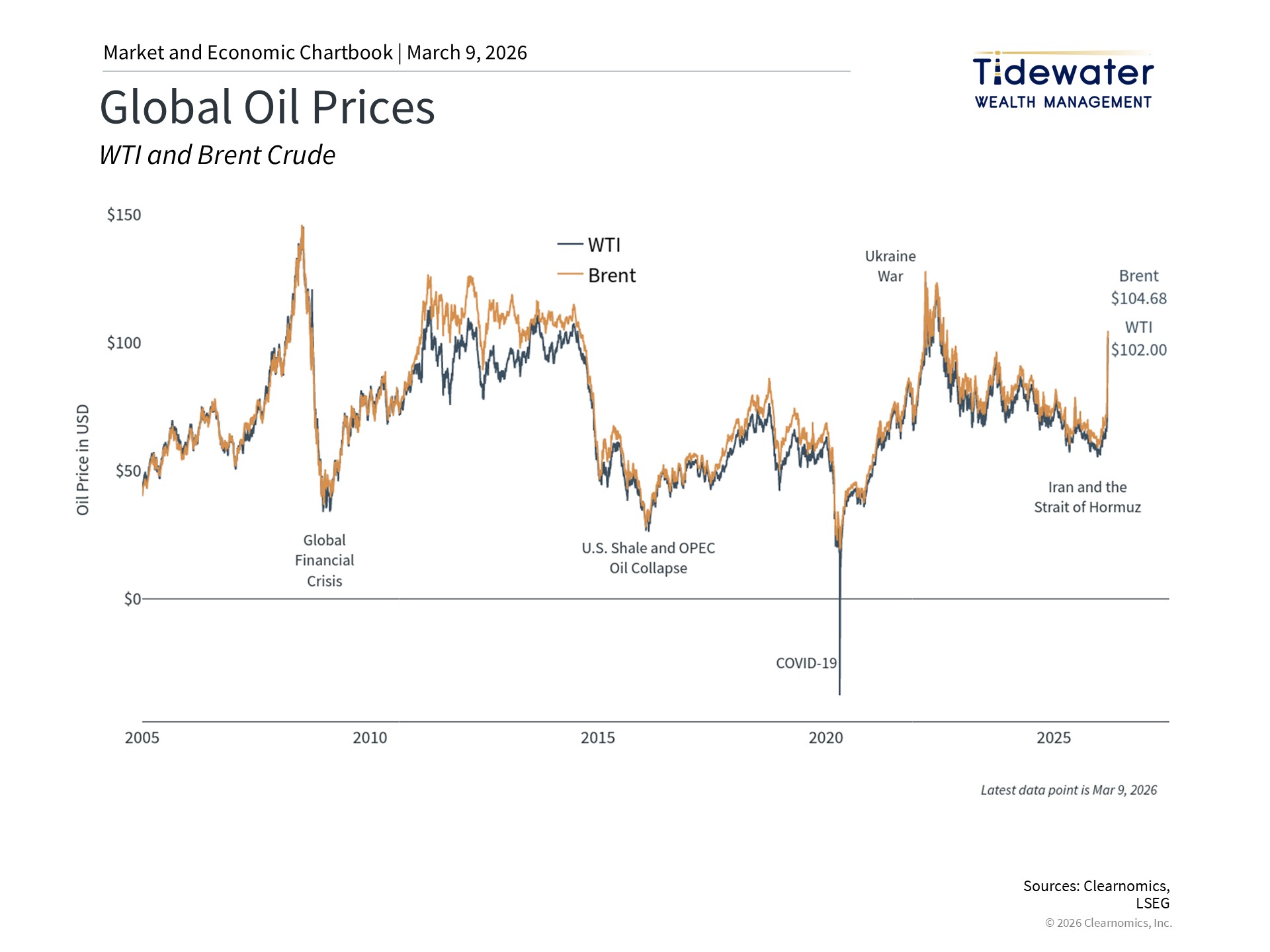
For investors, energy prices are the primary way that geopolitical events ripple through the broader economy and financial markets. The impact of each conflict differs depending on how it affects the supply and demand of oil. Currently, higher prices are being driven by disruptions to oil transportation, limited storage capacity, and production cuts by major oil-producing nations in the Middle East. The potential length of the conflict is also a factor, especially as Iran works to appoint a new supreme leader.
The focus of the current oil price surge is the Strait of Hormuz, a narrow waterway connecting the Persian Gulf to the broader world. Approximately 20% of the world’s oil shipments — along with a large share of natural gas — pass through this critical passage every year. While Iran cannot technically close the strait entirely, attacks on oil tankers and growing safety concerns have been enough to stop traffic. Major shipping and logistics companies have restricted or halted bookings through the region, leaving hundreds of oil tankers stranded inside the strait.
This blockage has set off a chain reaction in energy markets. Without the ability to ship oil through the Strait of Hormuz, large Middle Eastern producers have had to store their oil instead. As storage facilities fill up, countries including Saudi Arabia, Iraq, Kuwait, Qatar, and the UAE have been forced to cut production. Unlike the planned production cuts that OPEC sometimes uses to support prices, these reductions are involuntary and driven by circumstance. This sequence of events explains why oil prices have risen so dramatically in such a short period.
It is widely believed that when oil prices exceed $100 per barrel, economic activity begins to slow, squeezing household budgets and pushing up inflation. Even so, it helps to put these moves in historical context. Oil prices have experienced wide swings over the years. When Russia invaded Ukraine in early 2022, Brent crude surged to nearly $128 per barrel, pushing average U.S. gasoline prices above $5 per gallon. Before that, the mid-2000s saw oil reach record highs due to rapid global growth, right before the 2008 financial crisis. In each case, prices eventually stabilized as supply and demand found a new balance.
How higher oil prices affect consumers and businesses
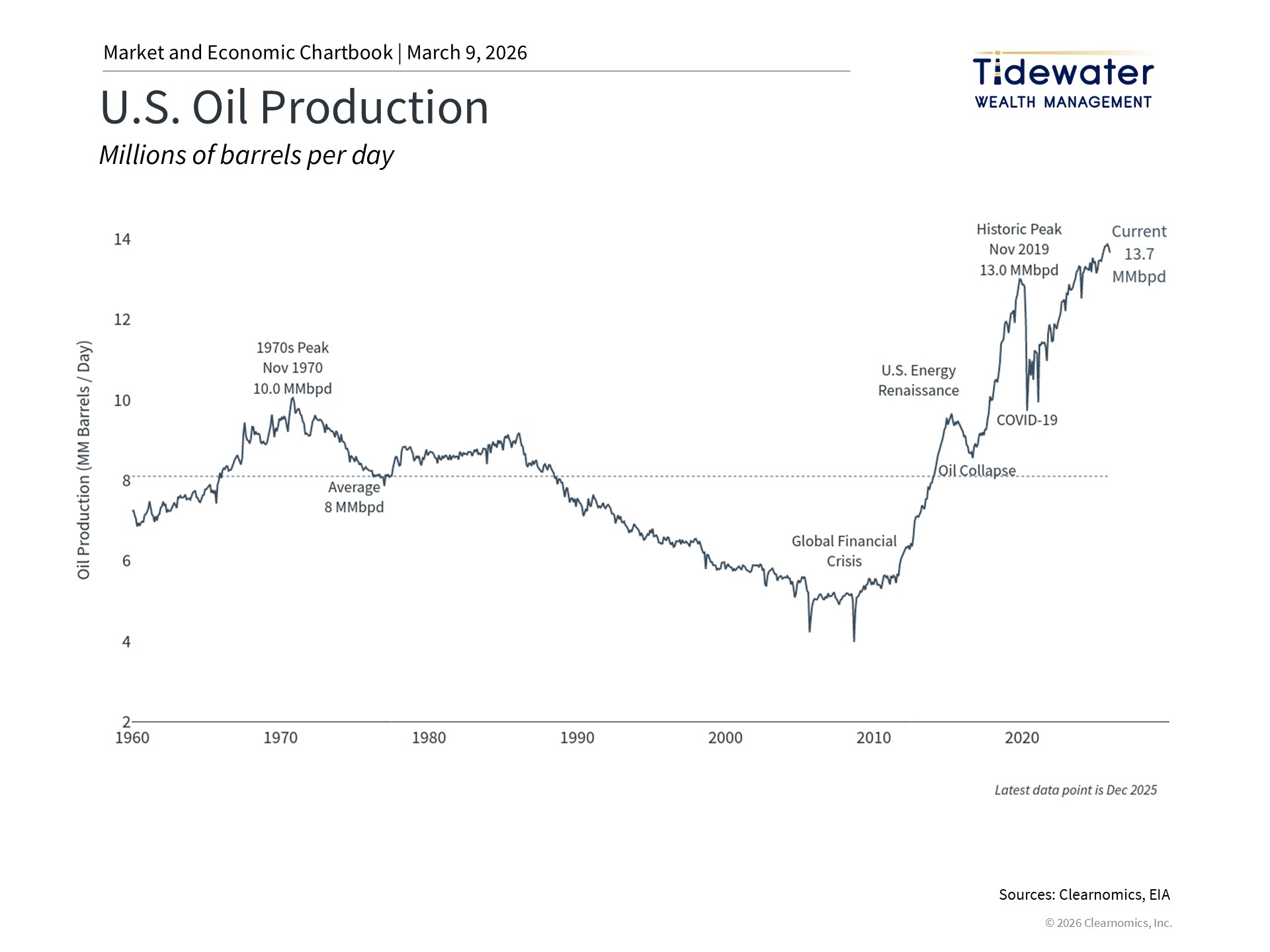
The United States is better positioned today than it was during earlier oil crises, largely due to the shale revolution — a major expansion in domestic oil and gas production that took place over the past two decades. As the world’s largest producer of both oil and natural gas, the U.S. now enjoys a degree of energy independence that did not exist in previous oil shocks. While oil is priced on a global market and the U.S. still imports some types of crude, this independence helps protect the domestic economy more than countries in Asia or Europe. The U.S. is also considered a “swing producer,” meaning it has the ability to increase production when oil prices are high.
That said, higher oil prices still affect nearly every part of the economy. For everyday consumers, the most noticeable impact is felt at the gas pump, where rising prices directly reduce the money available for other spending. Gasoline prices have climbed back toward $3.50 per gallon nationally, and could move higher. While that is a meaningful increase, it remains well below the $5 per gallon seen four years ago.
Beyond gasoline, higher energy prices have many indirect effects on what consumers pay for goods and services. When energy costs rise, businesses pay more to transport products, manufacture goods, and power their operations. These higher costs are typically passed on to consumers through higher prices, effectively reducing purchasing power across the economy.
Economists call this “cost-push inflation” — inflation that results from rising production costs rather than from increased consumer spending. This is different from “demand-pull inflation,” where prices rise because people are spending more, such as when government stimulus payments boost consumer demand.
This difference matters because supply-driven price increases are often seen by economists and investors as “transitory,” meaning they are temporary. Either the underlying situation resolves and oil prices fall, or the economy gradually adjusts to the higher price environment. While sudden energy price spikes are certainly disruptive, history suggests that they rarely cause permanent damage to the broader economy.
Markets have historically handled higher oil prices
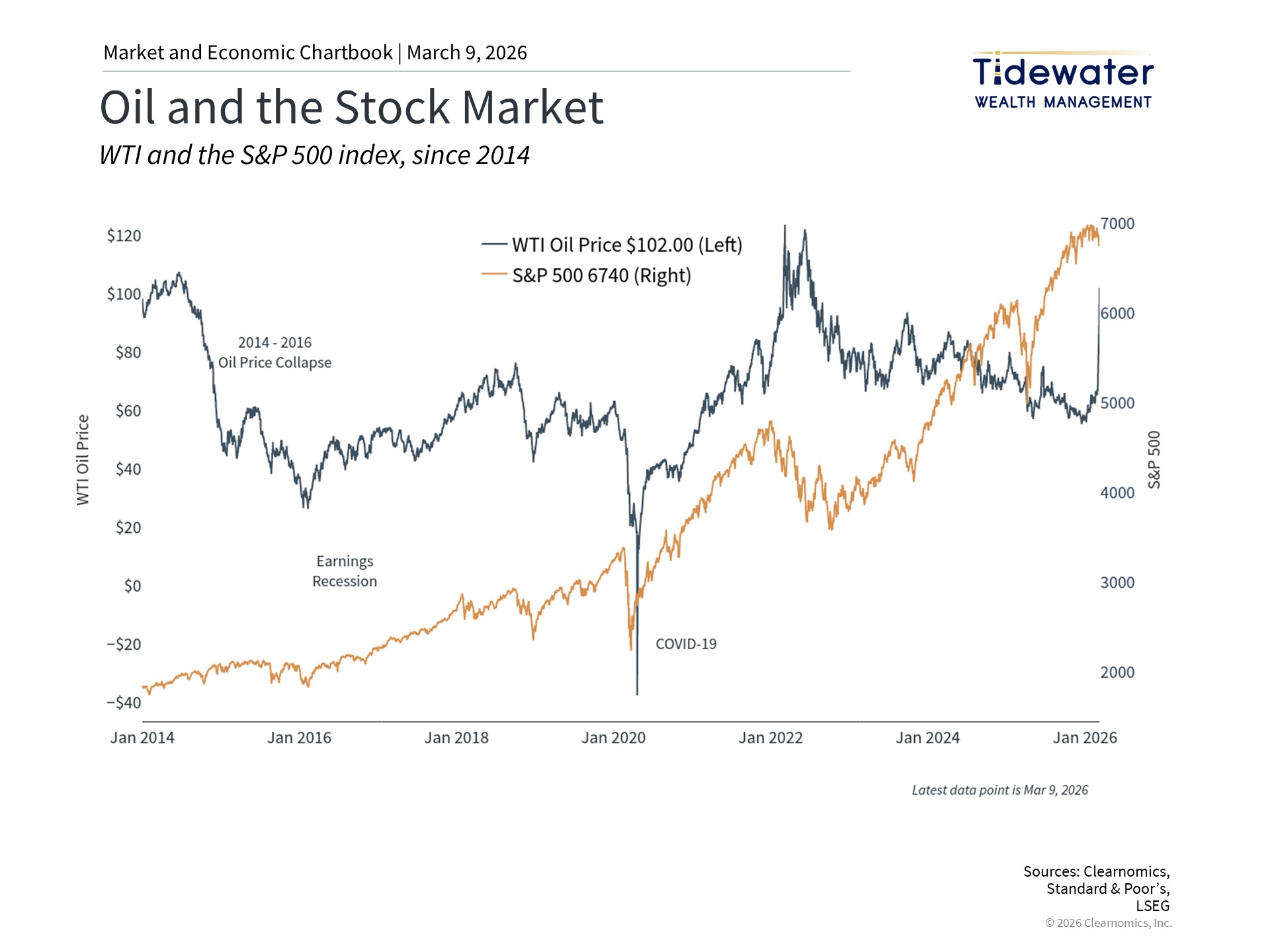
Despite these historical lessons, financial markets can still react sharply to oil price shocks in the short term. The S&P 500 — a broad measure of U.S. stock market performance — is only down a couple of percentage points so far this year. However, many headlines have focused on steeper declines elsewhere, such as South Korea’s KOSPI index falling 17% and Japan’s Nikkei index dropping 10% since the end of February. What those headlines often overlook is that the KOSPI and Nikkei are still up over 104% and 40%, respectively, over the past year, even after these recent drops. Markets never rise in a straight line, and keeping this broader perspective in mind is important.
On the other side of the equation, energy companies tend to benefit when oil prices rise. The energy sector has gained about 25% year-to-date and is leading the market — just as it did in 2021 and 2022. Similarly, the broader commodities asset class (which includes physical goods like oil and metals) has risen over 20% this year, driven by both energy prices and precious metals. This is not a suggestion to focus only on energy investments, but rather a reminder of the value of holding a variety of different asset classes and sectors in a portfolio.
Recent developments also create uncertainty around what the Federal Reserve — the U.S. central bank — may do next. If inflation rises due to higher oil prices, the Fed may need to keep interest rates higher for longer than currently expected. Right now, financial markets are pricing in at least one interest rate cut later this year in September, and possibly two by year-end. However, if the supply disruption turns out to be temporary — even if it lasts several months — its impact on Fed policy may be limited, as has been the case historically.
Of course, this does not mean that markets will stop experiencing day-to-day swings. Rather, it is a reminder that well-constructed investment portfolios and financial plans are specifically designed to handle these kinds of risks. Making big changes to a portfolio in reaction to news headlines is often counterproductive. Long-term investment success is more often the result of staying diversified and keeping focus on one’s financial goals.
The bottom line? While the conflict in Iran has pushed oil prices above $100 and created volatility, financial markets and the economy have historically adapted to supply shocks. Investors should maintain perspective, stay diversified, and continue to focus on their long-term financial goals rather than reacting to daily geopolitical headlines.
Advisory services provided by NewEdge Advisors, LLC as a registered investment adviser.