


Treasury rates have climbed to their highest levels in several years, driven by worries about inflation, oil prices, the national debt, and the Federal Reserve (the central bank of the United States, often called "the Fed"). The 10-year Treasury yield (the interest rate paid on U.S. government bonds that mature in 10 years) has risen back above 4.6%, and the 30-year Treasury yield has been above 5% for the longest stretch since 2007.1
In general, this is good news for long-term investors, since higher yields help portfolios generate income and stability.
What is especially worth noting is that real yields (bond yields after adjusting for inflation) have climbed even further. Understanding these moves matters because they affect many areas of investing and financial planning. Portfolios and financial plans should account for these changing interest rate conditions, particularly because they have shifted considerably over the past decade. So what exactly do investors need to know?
The difference between a nominal yield and a real yield is straightforward. A nominal yield is simply the stated interest rate on a bond, such as a corporate bond or a U.S. Treasury note. A real yield goes one step further by showing what an investor actually earns once inflation is taken into account. Real yields represent the true return for savers, making them a key measuring stick against which all other types of investments are compared.
Long-term real yields are near their highest point in many years
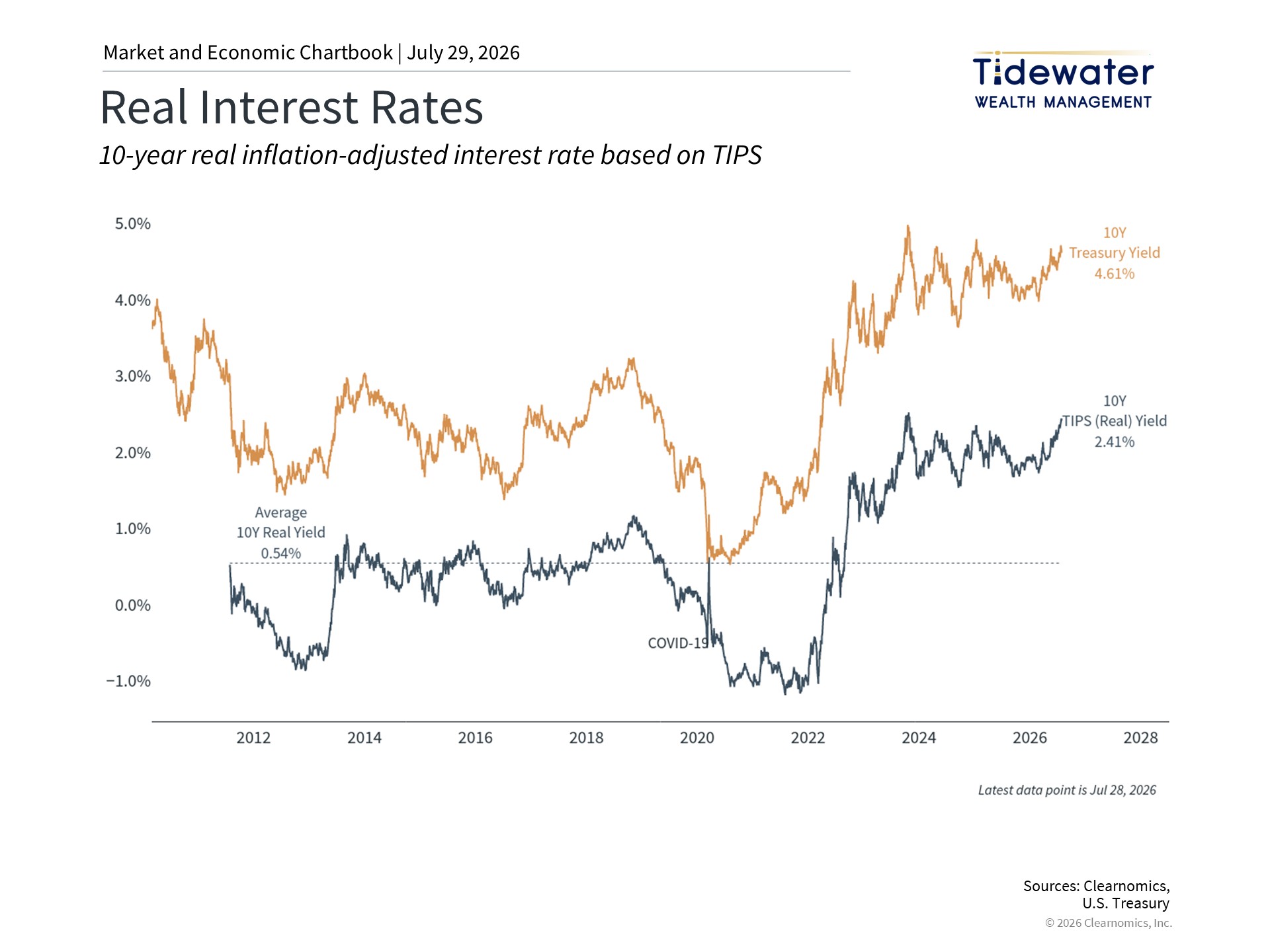
The chart above shows how real yields have changed over the past fifteen years or so. Back in 2020, real yields on government bonds actually turned negative. This meant that investors were either expecting very little inflation in the years ahead, or were willing to accept a guaranteed loss of purchasing power just to hold the safety of U.S. Treasury securities. This was largely intentional, as the Fed cut interest rates to support the economy and encourage investors to put money into stocks, real estate, and other investments with higher potential returns.
Yields changed direction in 2022 when inflation rose sharply, prompting the Fed to reverse course and raise its benchmark interest rate at the fastest pace in decades. Both nominal and real yields climbed significantly as a result. Today, the 10-year nominal Treasury yield stands at roughly 4.7%, while the corresponding real yield is 2.4%, well above levels seen since the global financial crisis. This reflects what markets expect inflation to average over the next ten years, not just the most recent figures.
Several factors are keeping long-term yields elevated. Oil prices have risen back above $90 per barrel for Brent crude amid the ongoing war in Iran, and gasoline prices have climbed back above $4 per gallon nationally.2
Higher energy costs can feed directly into broader inflation, which in turn pushes nominal yields higher. Notably, inflation expectations have not risen much based on market measures and surveys, largely because many anticipate the Fed may raise rates over the coming months to keep rising prices in check.
The growing national debt and federal budget deficit also create uncertainty for government bond yields. This affects what economists call the "term premium," which is the extra yield investors require to hold longer-term bonds rather than shorter-term ones. With the total national debt now above $39 trillion, larger interest payments naturally raise the cost of borrowing for the government, pushing U.S. Treasury yields higher.3
Higher yields have an impact across all areas of the market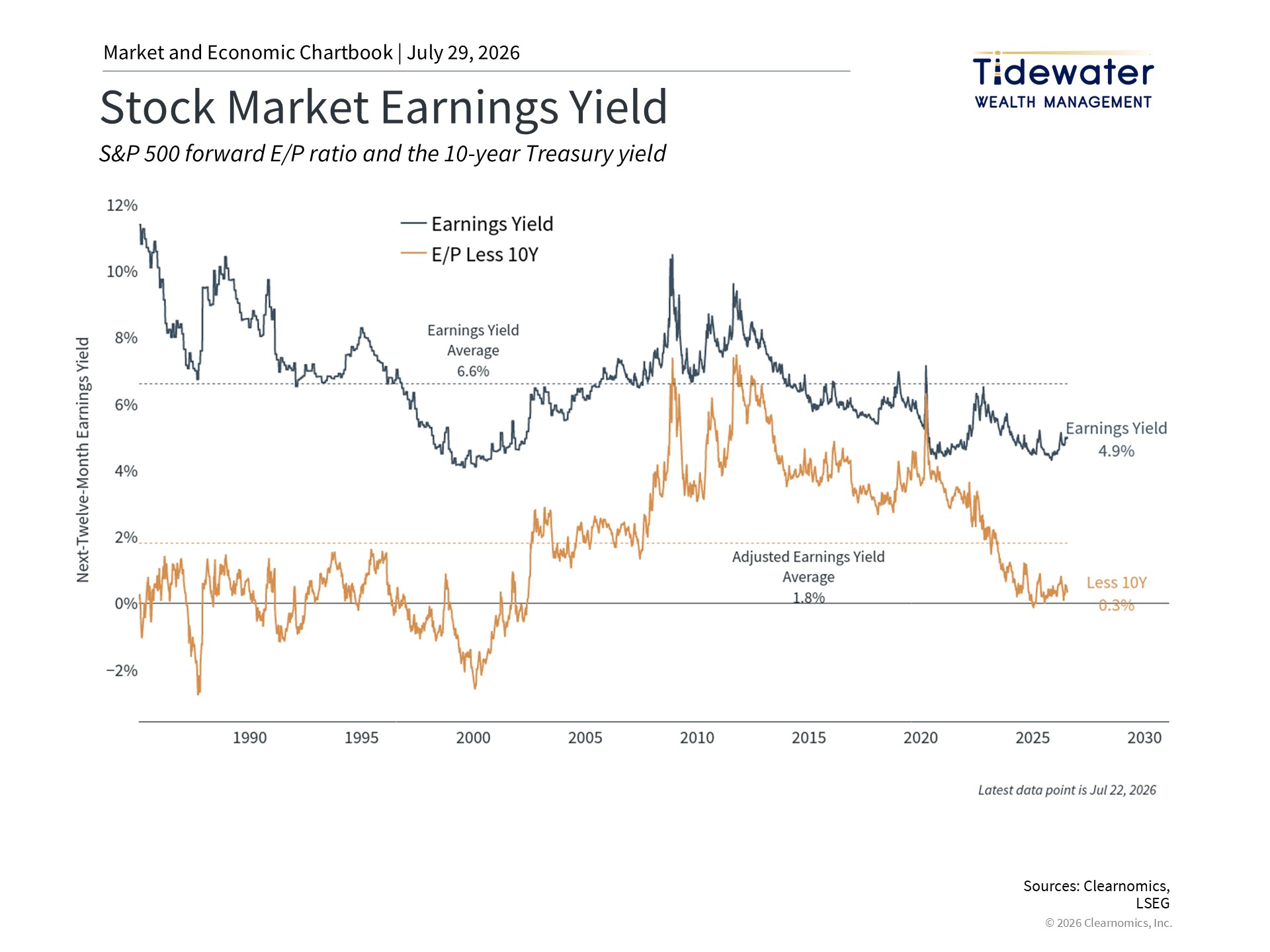
Interest rates do not just affect bonds. They also influence how appealing different types of investments look when compared to one another. This is especially important for long-term investors, since it shapes the relative attractiveness of different asset classes within a balanced portfolio. The chart above shows the S&P 500 earnings yield, which is calculated by dividing a company's earnings per share by the stock price. This is a useful measure for comparing the stock market to bond yields.
This comparison is often called the "equity risk premium," since it measures how much extra potential return is available for accepting the greater risk of investing in stocks. When real bond yields were near zero or negative, as they were for much of the period after 2008, stocks faced little competition. Investors accepted lower earnings yields from stocks because there were few other places to find yield and growth. This environment was commonly referred to as TINA, or "there is no alternative."
At current levels, the 10-year real yield of 2.4% means investors can earn an attractive, inflation-adjusted return simply from government bonds. The S&P 500 earnings yield sits at roughly 4.9%, corresponding to a forward price-to-earnings ratio of around 20x (a common measure of how expensive stocks are relative to their earnings). This means that carefully evaluating the mix of stocks and bonds in a portfolio is potentially more important now than it has been in years.4
The Fed's balance sheet and its effect on yields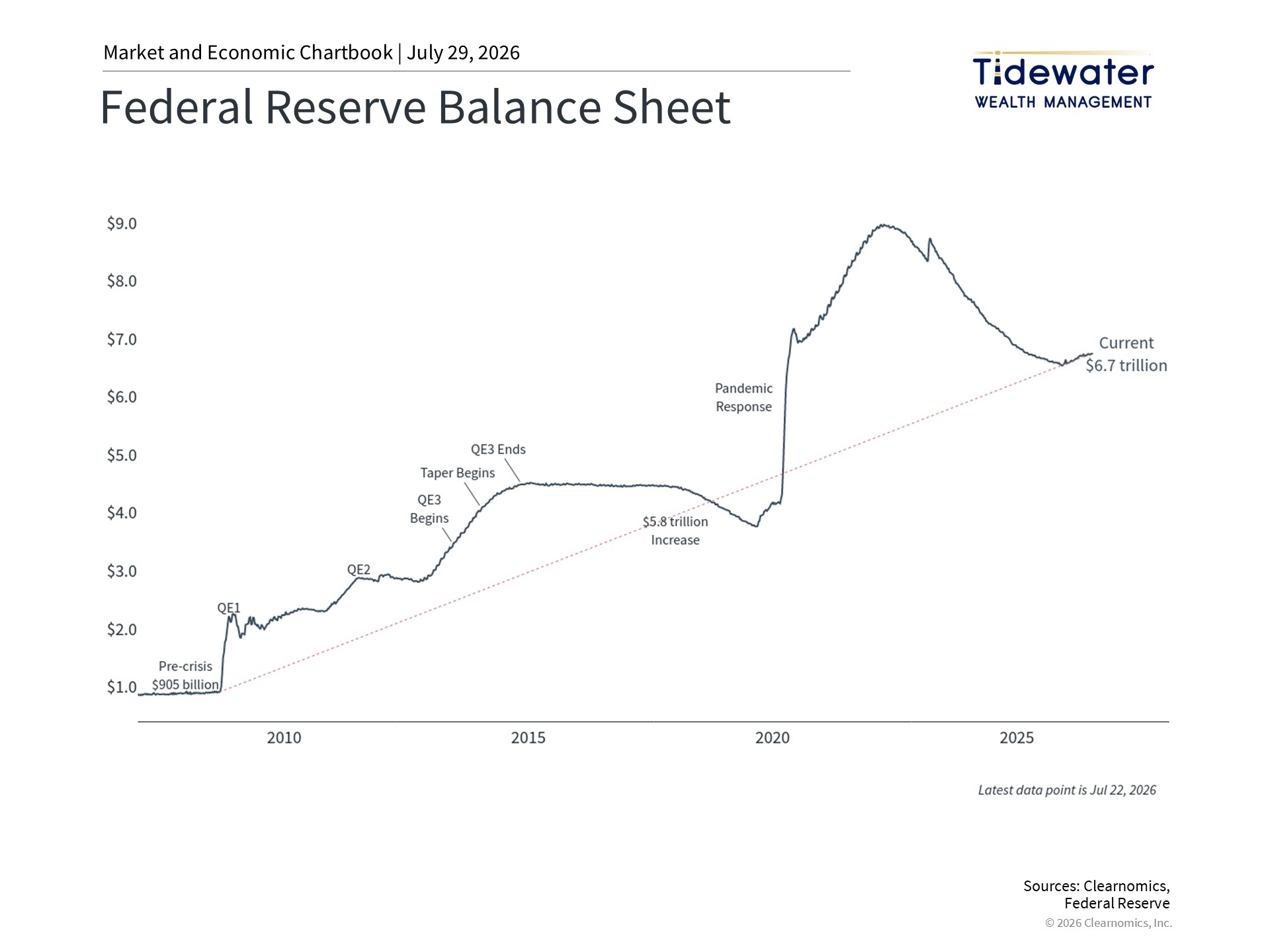
Another factor affecting bond yields is uncertainty around Fed policy under its new leader, Kevin Warsh. One task force he has launched seeks to address the central bank's $6.7 trillion balance sheet (the total value of assets, such as bonds, that the Fed owns). As shown in the chart above, the Fed's holdings have grown with each economic crisis. While the balance sheet has shrunk somewhat in recent years as assets have matured, it remains far larger than it was before 2008.
Warsh has long believed that the Fed should reduce its balance sheet when the economy is healthy. This would involve selling Treasury securities and mortgage-backed securities (bonds tied to home loans), which effectively pushes Treasury bond yields higher, raising borrowing costs for businesses and homebuyers. Combined with the expectation of Fed rate increases, these actions could keep both short-term and long-term interest rates higher for a longer period of time.
For long-term investors, this means that holding a thoughtful and well-considered mix of stocks, bonds, and other assets designed to meet financial goals is more important than ever.
The bottom line? Real yields are at their highest levels in years, driven by inflation concerns, fiscal uncertainty, and a shrinking Fed balance sheet. A thoughtfully constructed and well-balanced portfolio aligned with financial plans is more important than ever.
References
1. https://home.treasury.gov/policy-issues/financing-the-government/interest-rate-statistics
2. https://gasprices.aaa.com/
3. https://www.jec.senate.gov/public/index.cfm/republicans/debt-dashboard
4. Clearnomics research and LSEG data as of July 27, 2026
5. https://www.federalreserve.gov/monetarypolicy/task-forces.htm