

For most of stock market history, investing was mainly about picking individual stocks and bonds. But over the last several decades, big-picture economic events — sometimes called "macroeconomic" events — have had a growing influence on markets. Events like decisions made by central banks (which control interest rates), geopolitical conflicts, or changes in global trade now affect nearly every stock, regardless of how well an individual company is doing. This means that building a strong portfolio today is less about finding the right individual stocks, and more about deciding how to divide your money across different types of investments in a way that matches your financial goals.
This has been especially true over the past year and a half. The two biggest economic drivers during this period have been the war in Iran and U.S. tariff policy. Tariffs are fees charged on goods imported from other countries. Both of these factors affect the prices consumers pay and the demand businesses see, either directly through higher energy costs or indirectly through more expensive imported goods. Importantly, the effects of these kinds of events tend to ease over time. That’s why it’s important for investors to keep their focus on long-term trends rather than reacting to any single event by making sudden changes to their portfolios.
The conflict in Iran, gas prices, and what’s happening with OPEC
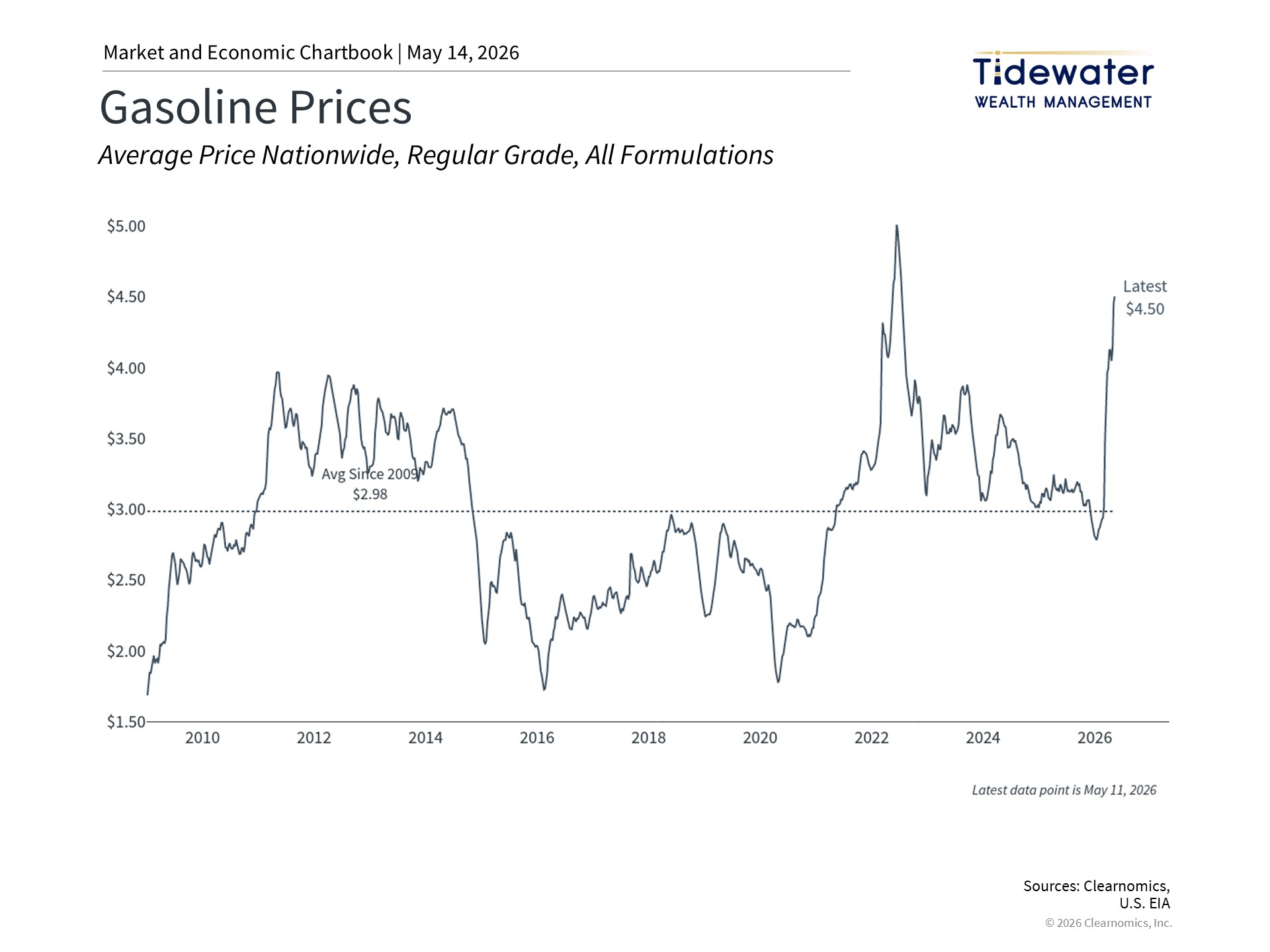
One of the most direct ways the conflict in Iran has affected everyday Americans is through the price of gasoline. The national average for regular unleaded gasoline has risen to around $4.50 per gallon. That’s well above the long-term average and a noticeable increase from just a few months ago. In some areas, prices are already above $6 per gallon.1 Since energy costs are a key part of the Consumer Price Index — a common measure of inflation, or the general rise in prices — this has pushed overall inflation higher, making the economic outlook more complicated after a period of improvement.
Some people may be reminded of the 1970s Arab Oil Embargo, when a sudden drop in oil supply caused inflation to surge and gasoline to be rationed. However, the world is very different today. The U.S. is now the world’s largest energy producer, pumping more than 13 million barrels of oil per day. This has made the U.S. economy less vulnerable to oil supply disruptions around the world.
Another sign of how things have changed is the recent decision by the United Arab Emirates (UAE) to leave OPEC. OPEC is a group of oil-producing countries that historically worked together to control global oil prices, mainly by agreeing on how much oil each member would produce. However, reaching and enforcing these agreements across roughly a dozen countries has always been difficult, and member countries often produced more oil than their agreed limits.
The UAE’s exit is a reminder that OPEC is no longer as powerful as it once was, as member countries increasingly follow their own strategies. At its peak in the 1970s, OPEC supplied at least half of the world’s oil. Today, that share is closer to one-third.2 A larger group called OPEC+, which includes Russia and other countries, was created to help coordinate more broadly, but the same challenges around cooperation still apply.
The reduced influence of OPEC doesn’t mean oil prices can’t spike during global conflicts, but it does mean prices are less tied to OPEC’s decisions than in the past. While that’s little comfort for households feeling the pinch of higher gas prices, it helps explain why the broader impact on financial markets has not been more severe.
Tariff policy continues to be challenged in the courts
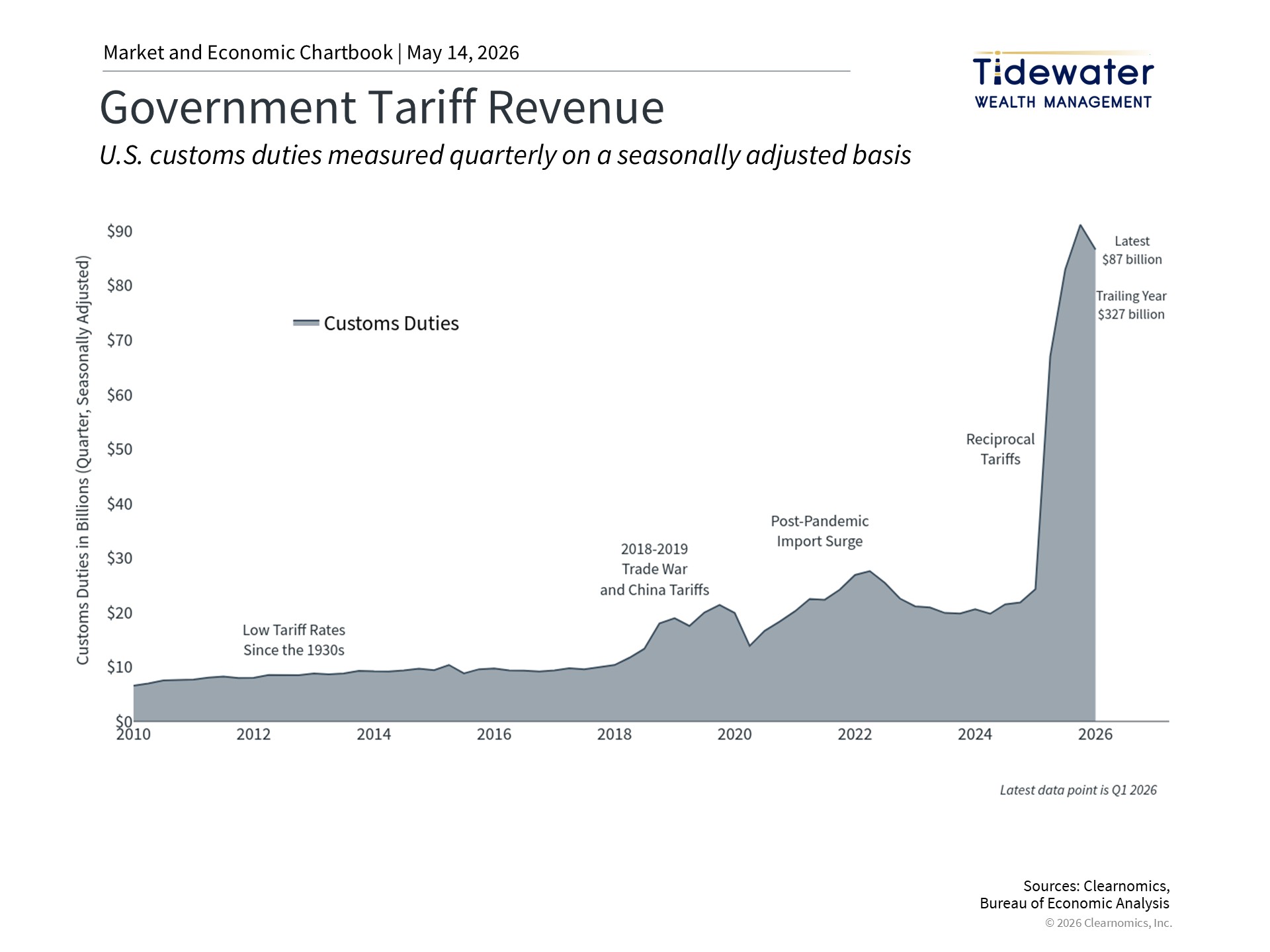
The second major economic story has been tariff policy, which has faced a series of legal challenges. In February, the Supreme Court ruled that tariffs put in place last April under a law called the International Emergency Economic Powers Act (IEEPA) were illegal.3 The administration then moved those tariffs under a different legal authority known as Section 122 of the Trade Act of 1974. More recently, the U.S. Court of International Trade ruled that these Section 122 tariffs are also unlawful.4
Despite these rulings, the administration is expected to keep pursuing tariffs as part of its broader strategy. There are other legal tools available, including Section 301 of the Trade Act of 1974, which allows tariffs to be applied after formal investigations into specific countries’ trade practices. Investigations of this kind have already been launched against dozens of countries, suggesting that tariffs are likely to continue — just applied more selectively on a country-by-country basis.
At the same time, the process of refunding previously collected tariffs is now underway. The agency that collects tariffs, Customs and Border Protection, has begun reviewing refund requests, and some businesses that paid the tariffs have already received payments.5 Estimates suggest the total refunds could amount to $160 to $170 billion.
While the exact amount and timing of these refunds is still uncertain, any money returned could improve earnings and cash flow for the businesses that paid them. From a purely economic standpoint, this represents money that was collected and is now being returned — so it’s not a brand-new benefit. Still, the refunds are a positive development for businesses and consumers alike.
Markets have hit new all-time highs even amid ongoing uncertainty
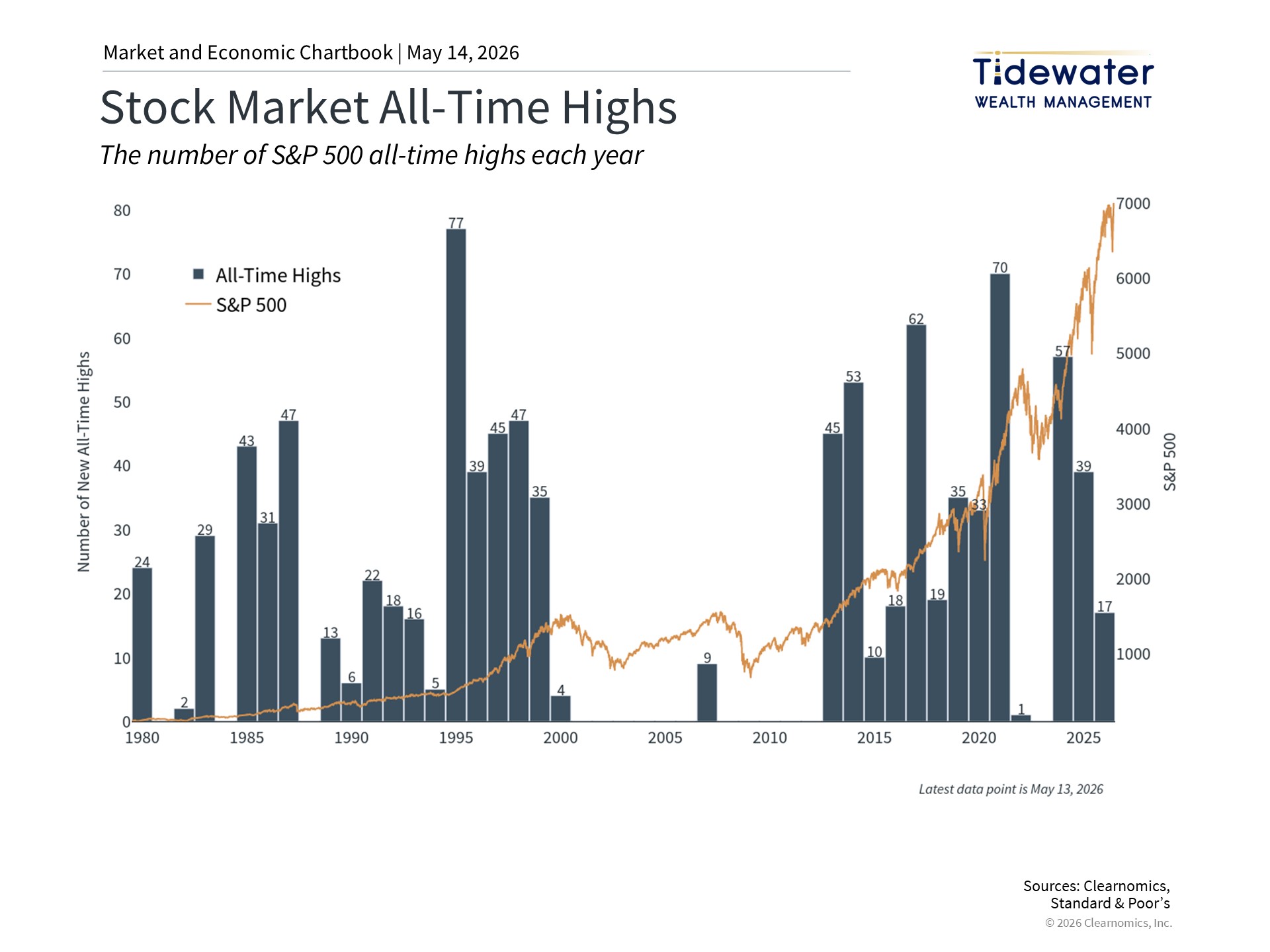
For investors, large-scale global events mean that entire markets and individual stocks can move up or down based on news that has nothing to do with any particular company’s performance. However, one consistent pattern is that the impact of these events on markets tends to fade over time. Headlines about wars, oil prices, tariffs, and other issues can cause short-term swings in prices — often called volatility — but they rarely determine what happens to markets over the long run.
This is why, despite all the uncertainty of the past year and a half, the S&P 500 — a widely followed index that tracks the performance of 500 large U.S. companies — has still reached more than a dozen new all-time highs this year. As the accompanying chart shows, new all-time highs are a normal part of long-term market growth, even when there is a constant stream of worrying news. What truly drives markets over time is the overall health of corporate earnings and economic growth, both of which have remained solid.
The bottom line? Today’s market environment is shaped by global forces that tend to come and go. Staying invested with a well-constructed portfolio remains the best way to navigate uncertainty and achieve long-term financial goals.
References
1. https://gasprices.aaa.com
2. https://www.eia.gov/international/content/analysis/special_topics/Global_Surplus_Crude_Oil_Production_Capacity/full-report.pdf
3. https://www.congress.gov/crs-product/LSB11398
4. https://www.cit.uscourts.gov/sites/cit/files/26-47.pdf
5. https://www.cbp.gov/trade/programs-administration/trade-remedies/ieepa-duty-refunds
Index Description
The Standard & Poor’s 500 Index is a capitalization-weighted index of 500 stocks designed to measure performance of the broad domestic economy through changes in the aggregate market value of 500 stocks representing all major industries.