


In recent weeks, stock market swings have been largely driven by rising oil prices and ongoing geopolitical tensions. Brent crude oil — a widely used benchmark for oil prices — has climbed back above $100 per barrel. This raises concerns about whether higher energy costs could slow down the economy and push prices higher overall, a situation known as inflation. These concerns come on top of existing worries, such as how artificial intelligence is affecting established businesses, whether stock prices are too high relative to their value, issues in private credit markets, and what the U.S. Federal Reserve (the central bank that manages interest rates) will do next. Understandably, all of this can leave investors wondering about the health of their portfolios.
Author Alfred A. Montapert once wrote, "do not confuse motion and progress." When markets move up and down every day because of global news, it can be tempting to think that portfolios and financial plans need constant adjustments. However, a key principle of good financial planning is that by the time uncertainty arrives, the hard work should already be done. A well-built portfolio holds a balanced mix of different investment types — known as asset classes — and is aligned with your long-term financial goals. This kind of portfolio is designed to handle different market conditions without needing constant changes.
That said, markets without a clear direction can feel unsettling. During times like these, keeping a calm and level-headed perspective is especially important when there is so much negative news. It is more critical than ever to stay focused on long-term goals, because saving and investing wisely remain the best ways to build wealth over time. So, what should investors keep in mind as uncertainty continues?
Market pullbacks are an unavoidable part of investing
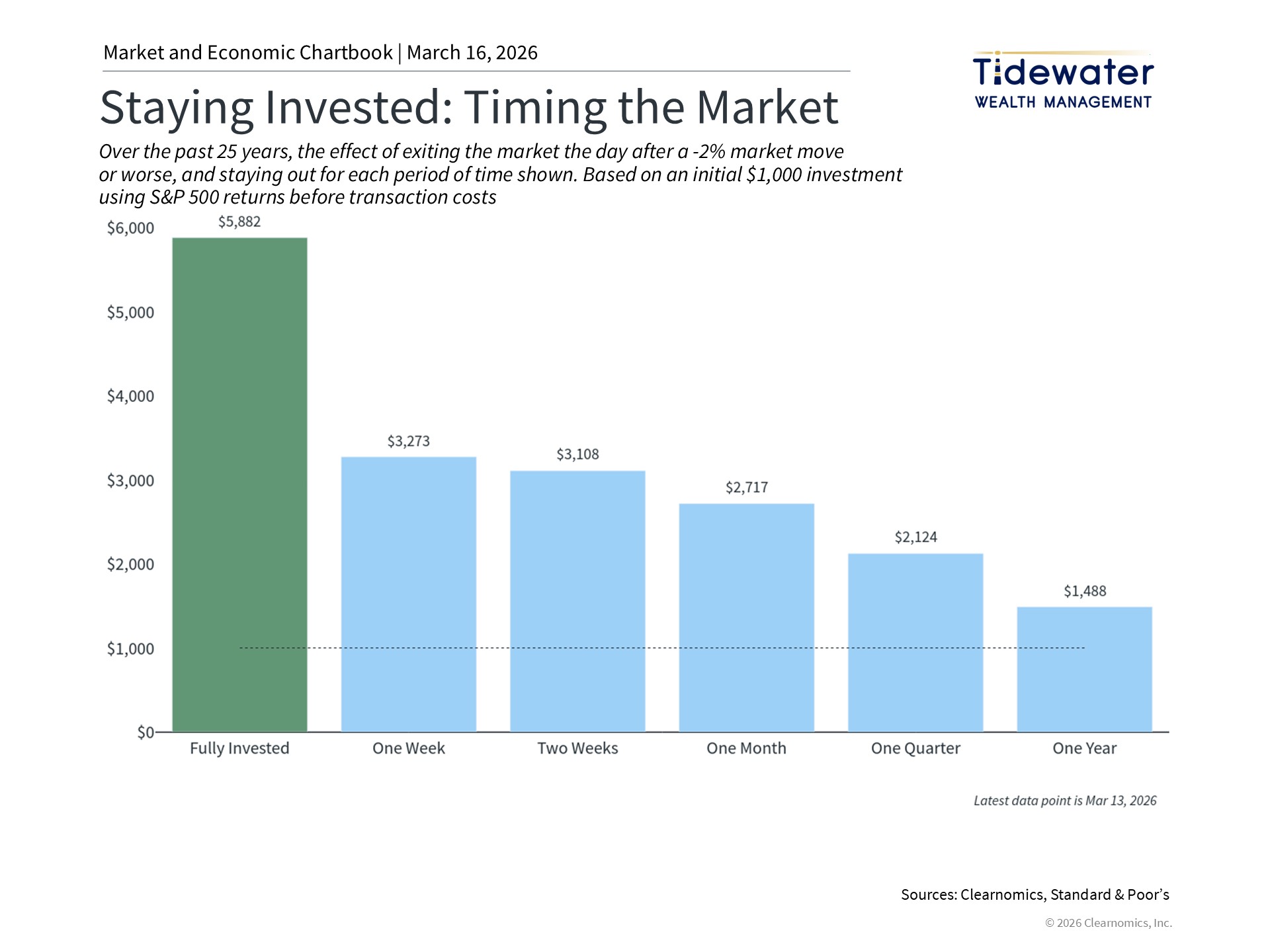
The stock market has been unsteady this year, with the S&P 500 — a widely followed index that tracks the performance of 500 large U.S. companies — sitting roughly 5% below its all-time high reached in January, as of mid-March. While recent market moves may feel unsettling, declines of this size are completely normal. In fact, in a typical year, the market experiences several drops of 5% or more over weeks or months before recovering. In 2025, for example, there were six such pullbacks for the S&P 500, driven mainly by tariffs, yet the market still delivered a total return of 18% for the year.
This is the foundation of why staying invested has historically been the best strategy for long-term investors. Some investors may be tempted to time the market — meaning they try to sell before prices fall and buy back in before they rise. The challenge, however, is not just knowing when to exit, but also when to re-enter. The accompanying chart shows that even missing just one week of trading after a volatile period has historically hurt investment outcomes. While there are no guarantees, this is largely because the market’s best days have tended to follow closely after its worst days. Investors who stepped away from the market missed the very rebounds they were waiting for.
This is not to say that market pullbacks are insignificant or that markets always bounce back quickly. Rather, it means that declines are a recurring feature of investing that should be planned for in advance, not reacted to in the moment.
Bond yields are attractive amid recent volatility
While the stock market tends to grab most headlines, the bond market is equally important. Bonds are essentially loans that investors make to governments or companies in exchange for regular interest payments. One of the key forces affecting bonds is the possibility of inflation — when prices for goods and services rise over time — and higher oil prices have raised fresh questions about this in recent weeks. Adding to the uncertainty is the upcoming transition to a new Federal Reserve chair in May, along with questions about whether the central bank may change its plans for interest rates. Currently, financial markets expect only one interest rate cut by the end of this year.
Bonds are a core part of many portfolios because they often act as a cushion against stock market volatility. However, the Middle East conflict has also affected bonds, with the Bloomberg U.S. Aggregate Bond Index — a broad measure of the U.S. bond market — roughly flat so far this year. The 10-year U.S. Treasury yield, which reflects what the government pays to borrow money for 10 years, has jumped back above 4.2% after falling as low as 3.9% when the conflict in Iran began.
Some perspective is helpful here. After a historic decline in 2022, when inflation and interest rates rose sharply, bonds have contributed positively to portfolios, delivering strong returns from 2023 to 2025. Since hitting their lowest point in October 2022, broad bond markets have generated roughly 20% in total returns, with some specific bond sectors performing even better.
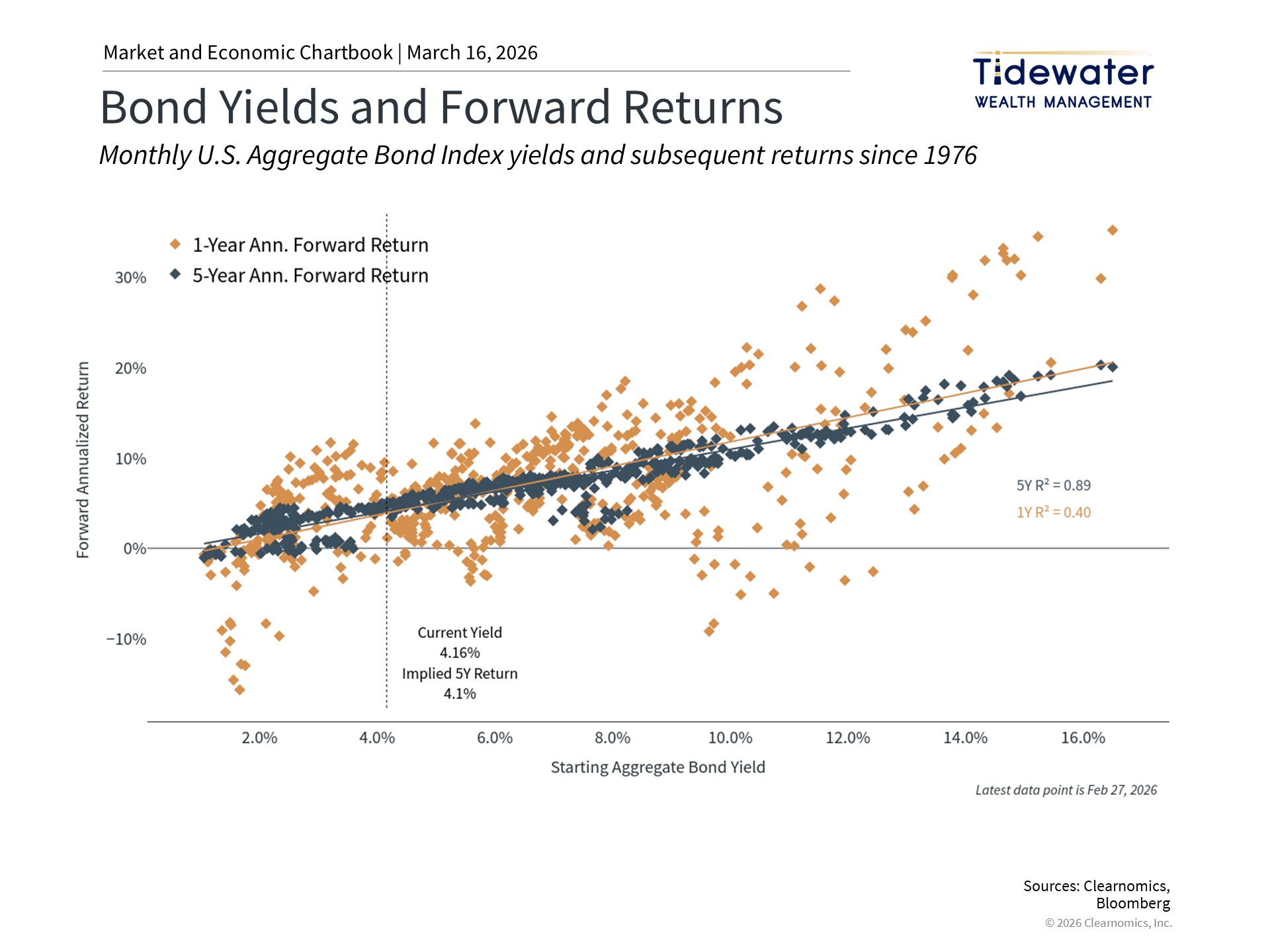
For long-term investors, bond yields — the income earned from holding bonds — remain attractive compared to the previous decade. The current yield on the U.S. Aggregate Bond Index is 4.5%, well above the 2.9% average since 2009. Historically, investing in bonds when yields are higher has been associated with stronger total returns over time, as shown in the accompanying chart.
This is especially relevant when compared to holding cash. Cash yields are still negative in "real" terms, meaning after adjusting for inflation, you are actually losing purchasing power. On average, $10,000 invested in certificates of deposit — a type of savings account with a fixed interest rate — yields about $155 a year, which is still well below inflation running between 2.5% and 3%. For those in or near retirement, inflation can feel even more pronounced due to rising medical expenses and insurance costs. So, while cash may feel safe, a proper allocation to bonds is still the best way to generate income and support long-term growth.
It is also worth noting growing concerns around private credit — an asset class made up of loans to companies that are made by non-bank lenders rather than traditional banks. There have been reports of rising requests to withdraw money from these investments and some larger funds limiting withdrawals. The sector has grown significantly in recent years and is tied to areas of market uncertainty such as technology and energy. Unlike publicly traded bonds, private credit is structured as a long-term investment precisely because it involves this type of uncertainty. Like any other asset class, what matters for investors who hold private credit is whether it is appropriate for their individual situation and how it fits within their broader portfolio.
Having a portfolio perspective continues to benefit investors
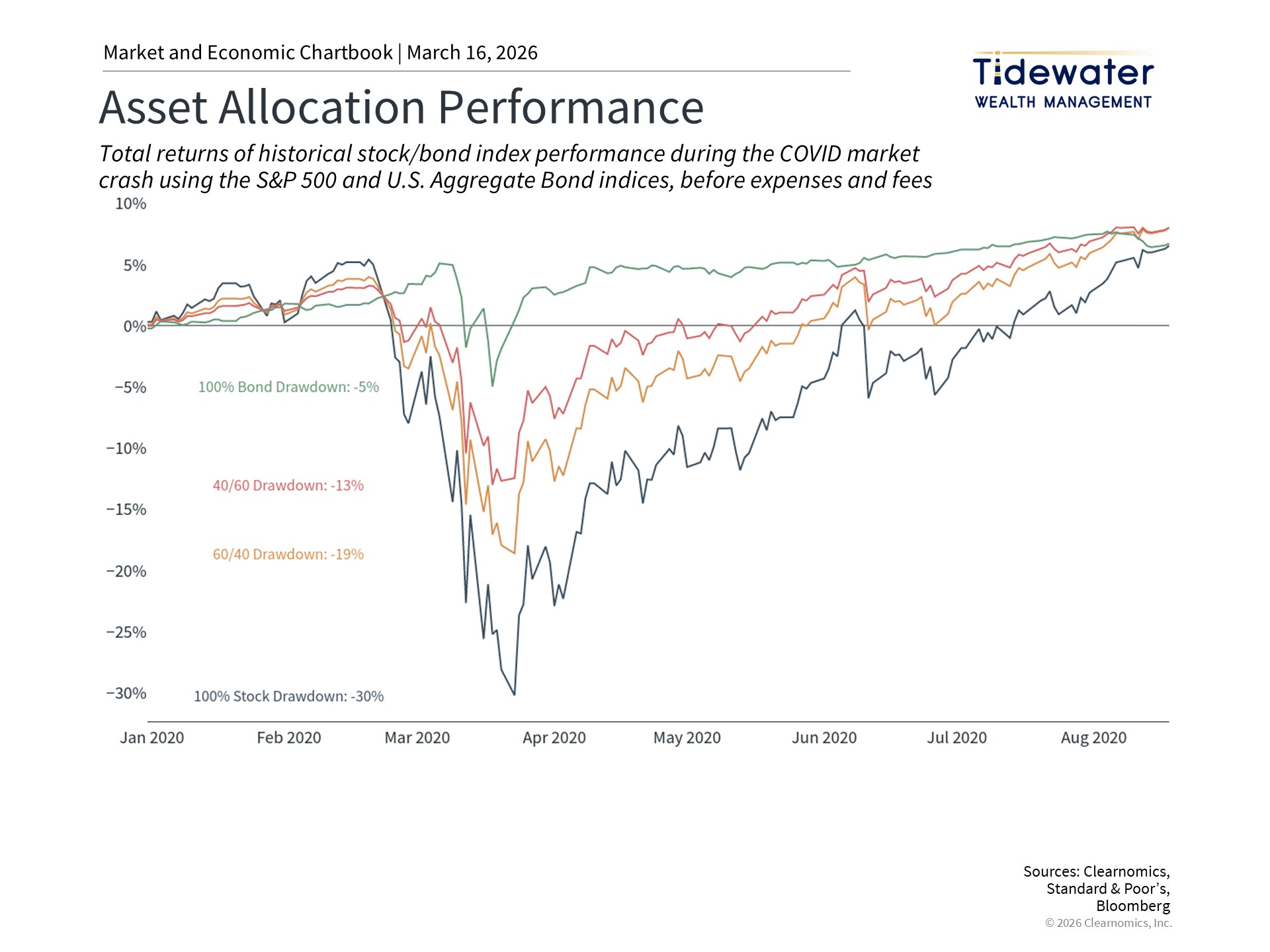
While each asset class has its own considerations, recent weeks highlight the value of a well-constructed portfolio. Holding a variety of different investments — whether across asset classes, specific market sectors, or different regions of the world — helps smooth out portfolio performance during turbulent periods. This reduces the temptation to make sudden changes that can get in the way of long-term financial plans.
The accompanying chart highlights one of the most volatile periods in modern history: the market downturn during the pandemic in 2020. Different portfolio mixes behaved in distinct ways during that time, with more balanced portfolios experiencing smaller swings in value. While these portfolios all recovered to similar levels after the turbulence passed, the real question is whether investors would have made impulsive decisions when stocks were down 20% or 30%.
Today, assets like commodities — which include physical goods such as oil, gold, and other raw materials — are leading market performance due to strength in energy and precious metals. However, the goal is not to guess which asset class will perform best next and concentrate a portfolio there. Instead, it is about benefiting from the full range of market movements. When one part of a portfolio struggles, another may help provide balance. Over time, this approach has allowed investors to participate in market growth while managing risk — which is ultimately what achieving long-term financial goals requires.
The bottom line? Market volatility driven by oil prices and geopolitical uncertainty is uncomfortable but not unusual. Staying invested with a diversified portfolio remains the best way to turn short-term swings into long-term progress.
Advisory services provided by NewEdge Advisors, as a registered investment adviser.