


We rely on computers and smartphones every day without thinking much about what goes on behind the scenes. In reality, making these devices work involves incredibly complex engineering and global supply chains that bring millions of products to life.
Artificial intelligence (AI) works in a similar way. Using an AI chatbot feels simple, but there is a complex system behind it that makes those capabilities available to anyone with a device. This would have sounded like science fiction just a few years ago. Generative AI and large language models (LLMs), which are AI systems trained on huge amounts of text to understand and generate language, have become one of the most important forces shaping financial markets and the broader economy. That is why it helps to look at AI as more than just a handful of technology stocks.
There is little question that AI is a major development, but it is still hard to predict how much demand there will be or how it will affect businesses, workers, and productivity in the years to come. For investors, that uncertainty can make it difficult to figure out what companies, industries, and the overall stock market are really worth. So how can investors build a clearer picture of AI's impact while keeping a long-term view?
The entire AI supply chain is supporting markets
One of the most useful things investors can understand is that "AI" is not one single type of investment. It is easy to focus on the companies that build AI models, such as OpenAI, Anthropic, and Google. But those companies are just one part of a much larger system. There is a full supply chain that spans many different industries and business models, each with its own opportunities and risks. This includes computer hardware, data centers, software companies, and more.
At the base of this supply chain is the computer hardware that makes AI possible. Specialized chips called GPUs (graphics processing units) and memory chips are needed at two key stages. The first is model training, which is the process of building an LLM by feeding it enormous amounts of data across thousands of connected servers. This process can take weeks or even months to complete.
The second stage is called "inference," which simply means the actual use of an AI model by a person or a business. Every time someone types a question into an AI tool, computing power and memory are needed to produce a response. Both training and inference together explain why demand and prices for AI hardware have risen sharply, pushing up the market value of companies that make these chips.
As demand grows, more hardware needs to be added, and that is where data centers come in. Think of a data center as a very large warehouse filled with rows of servers, which are powerful computers that store and process information. These servers run around the clock and require electricity, cooling systems, and security. All of this represents a massive investment in the physical resources that make AI applications available to users everywhere.
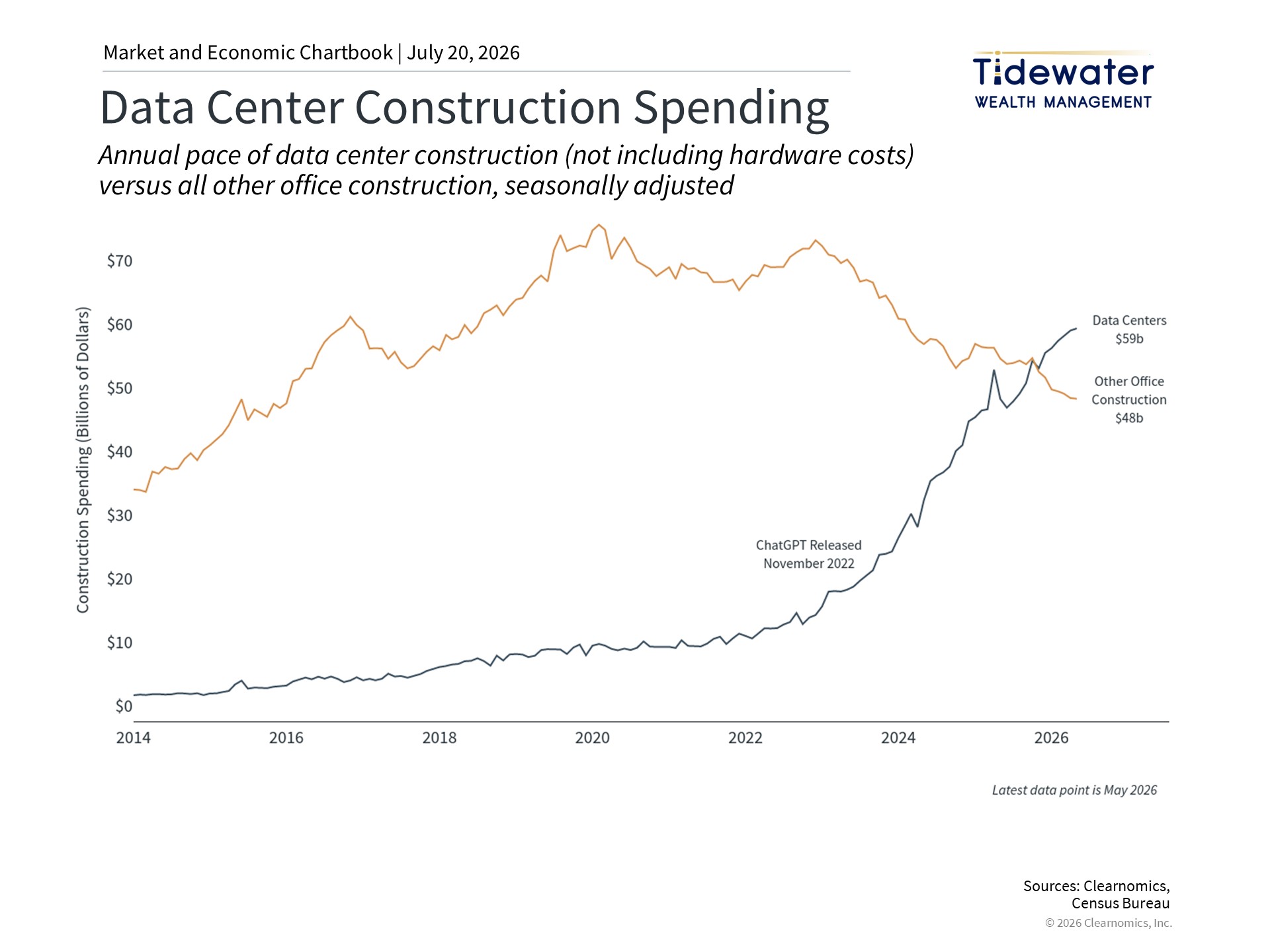
Spending on data centers has become a meaningful part of economic activity. The chart above shows how much money has been spent on data center construction alone, not counting the computer equipment inside. This spending picked up significantly after ChatGPT launched in late 2022, and has now exceeded spending on all other types of office construction. It is worth noting that not all of this growth is strictly tied to AI. The broader adoption of technology and automation, especially since 2020, has also driven greater need for computing resources.1
Finally, there is the question of how businesses are actually using AI, both for their own internal operations and through new AI-powered products from software companies. This part of the picture is perhaps the hardest to assess right now, because it depends on how well companies can turn AI tools into real productivity gains and better products. For example, how AI will work alongside existing software, and whether traditional software companies will adapt successfully, has been a source of uncertainty in markets over the past year.
Investors are weighing whether large investments will pay off2
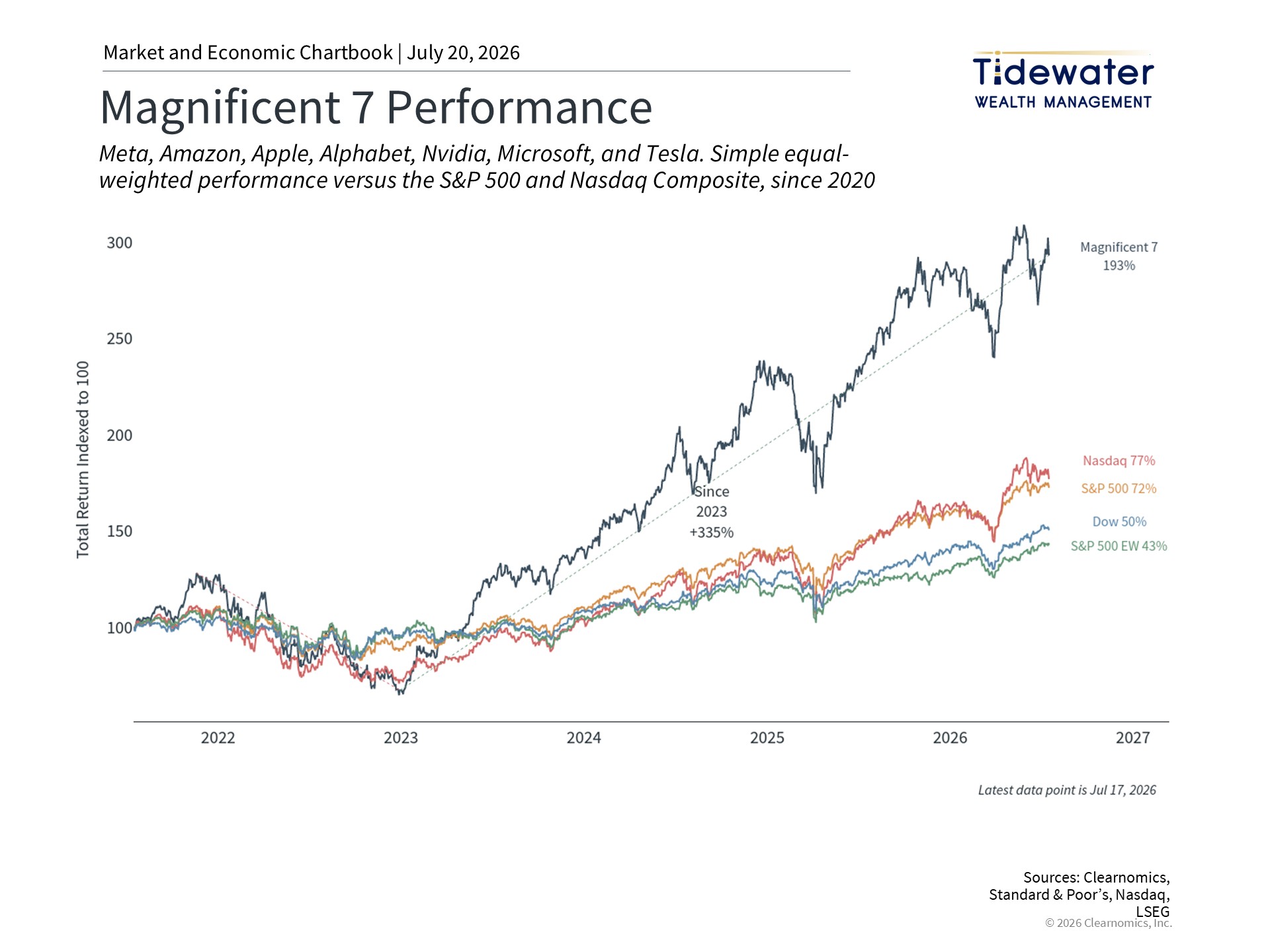
A key question for investors today is whether the hundreds of billions of dollars being spent on AI infrastructure will eventually produce strong enough returns to justify the cost. This is a difficult question, especially given the enormous scale of spending by some of the largest technology companies. The demand for computing power to train and run AI models has been strong, which has benefited companies that supply hardware and data center capacity. At the same time, as AI models improve, they may also become more efficient, meaning they could accomplish the same tasks using less computing power over time.
This uncertainty helps explain some of the ups and downs seen in AI-related stocks. As the chart shows, large technology companies have delivered strong returns over recent years, but with significant swings along the way. Because building new data centers takes time, periods of optimism about infrastructure spending have often been followed by periods of concern about whether demand will hold up.
Since early 2025, for example, investors have worried that more efficient AI models could reduce the need for computing power. However, history offers a useful perspective here through what is called the "Jevons paradox." This is the idea that when a technology becomes cheaper and more capable, overall demand for it often increases rather than decreases, because more people use it and new uses are discovered. Electricity, for instance, is no longer just for light bulbs, and personal computers are no longer just for large corporations.
At the same time, markets have a long history of overestimating how quickly new technologies begin generating profits, even when the long-term potential turns out to be real. The excitement around internet stocks in the late 1990s and early 2000s took many years to fully translate into business results. This is why a broader perspective on the many companies involved in AI, combined with a patient, long-term outlook, is so important as the technology and demand continue to develop.
Stock prices already reflect high hopes for AI growth
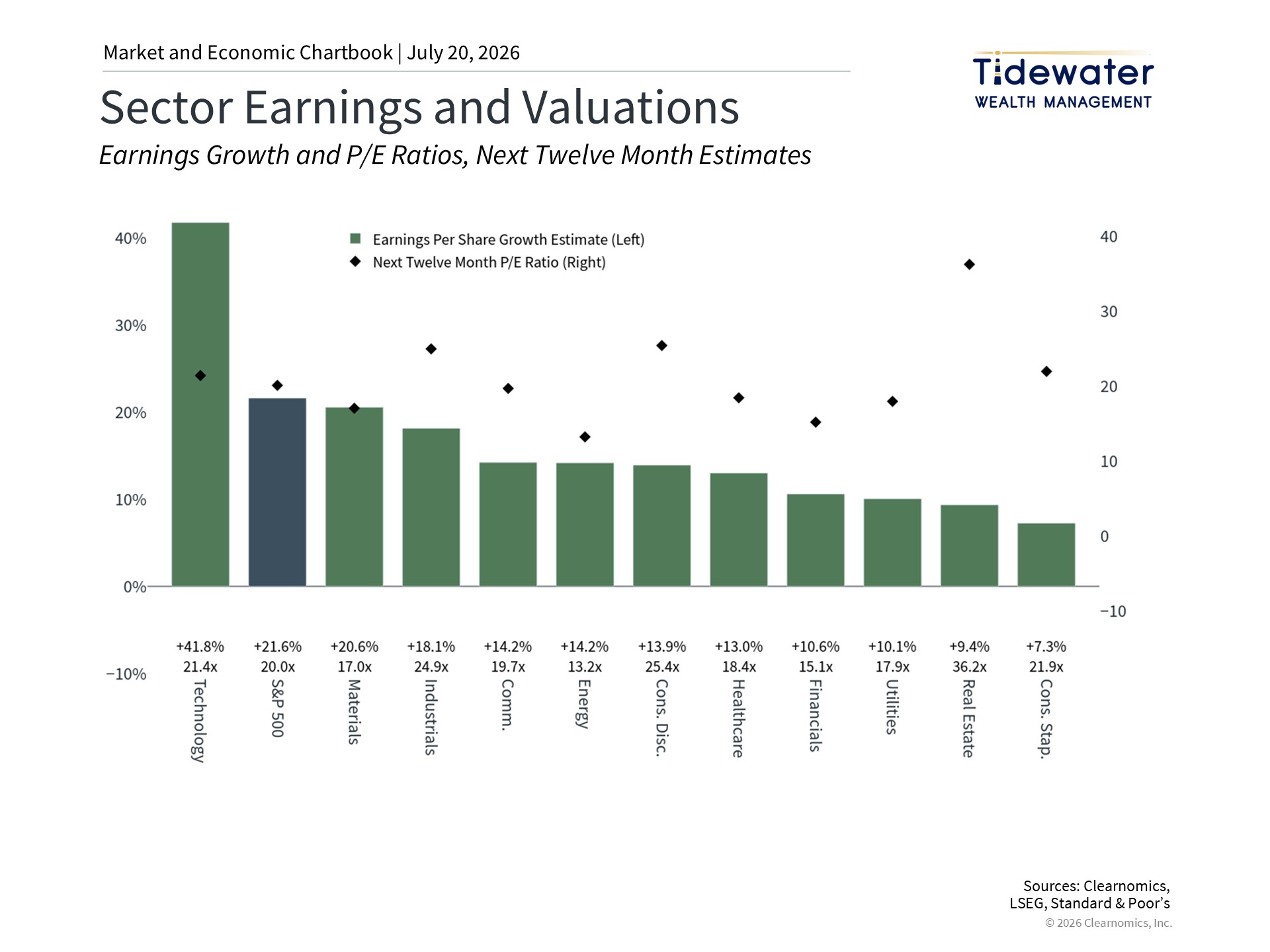
As AI has attracted more investor attention, the valuations of many technology companies have climbed. Valuation is a way of measuring how expensive a stock is relative to the earnings, or profits, a company generates. As the chart above shows, the Information Technology sector is currently priced at 21.4 times earnings, which is high compared to its own historical range and to the broader stock market. The same is true for sectors like Communication Services and Consumer Discretionary, which also include major technology companies. That said, these higher valuations also reflect the strong earnings growth these companies are delivering as demand for AI products and services expands.3
It is worth keeping in mind that valuations cannot tell us what the market will do in the short term. What they can do is help investors think about how to balance a portfolio, particularly when aligning investments with personal financial goals. While AI trends offer real opportunities for growth, many other sectors of the market are priced more attractively and also have strong earnings growth potential. As always, the key is to keep perspective, balancing exposure to AI themes alongside the rest of the market in a way that supports long-term financial goals.
The bottom line? The trends driving AI go beyond a few technology companies. While these themes are driving markets, it's important to maintain a broader perspective and longer time horizon with a focus on long-term financial goals.
References
1. https://www.census.gov/construction/c30/c30index.html
2. The Magnificent 7 companies include Meta, Amazon, Apple, Alphabet, Nvidia, Microsoft, and Tesla. Data as of July 17, 2026
3. Clearnomics research and LSEG data as of July 17, 2026
Index Descriptions
S&P 500
The Standard & Poor's 500 Index is a capitalization-weighted index of 500 stocks designed to measure performance of the broad domestic economy through changes in the aggregate market value of 500 stocks representing all major industries.
NASDAQ
The NASDAQ Composite Index measures all NASDAQ domestic and non-U.S. based common stocks listed on The NASDAQ Stock Market. The market value, the last sale price multiplied by total shares outstanding, is calculated throughout the trading day, and is related to the total value of the Index.