


Lately, it’s hard to open the financial news without seeing a headline about bond yields. For most people, that’s background noise. For us, it’s a conversation we’re already having, the kind we have with every household we work with, one at a time. Here’s how we’re thinking about it, and what it might mean for you.
WHAT’S ACTUALLY HAPPENING
Bond yields have moved sharply higher in recent months. That alone isn’t the story, since yields rise and fall. What matters is why.
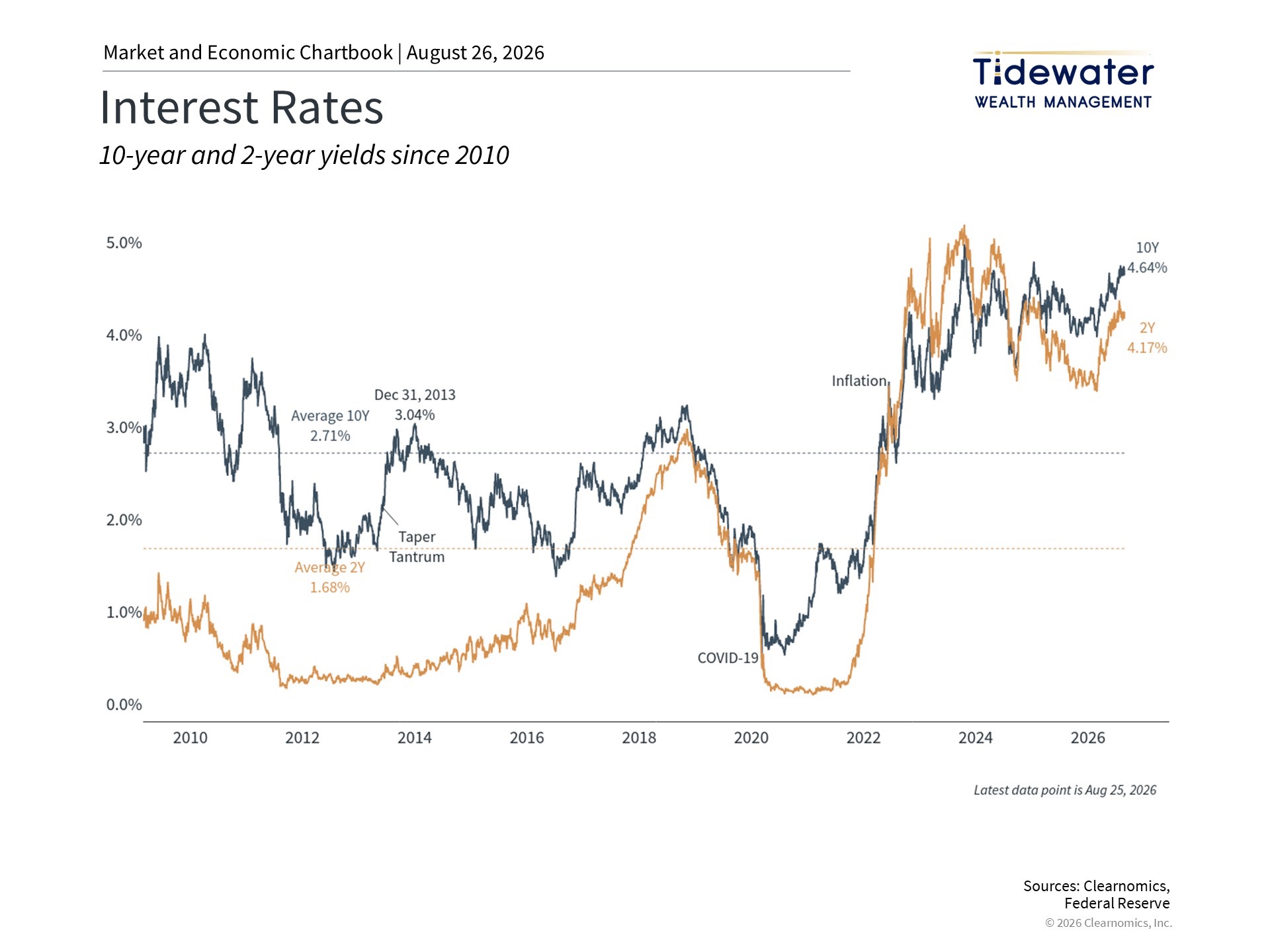
As of August 25, 2026, the 10-year Treasury yield stood at 4.64% and the 2-year at 4.17%, both well above their respective long-term averages of 2.71% and 1.68%.
Source: Clearnomics, Federal Reserve.
Rising Treasury yields typically reflect investors demanding more compensation for risk: inflation, large government deficits, heavier borrowing, and uncertainty about where interest rates go next. Lately, the conflict with Iran and the risk of higher energy prices have added another layer of inflationary pressure to that list. It’s been most visible at the long end of the curve: the 30-year Treasury yield touched 5.32% on August 18, its highest level since 2007 (a 19-year high), before easing slightly.
A few forces are converging at once. Inflation remains above the Federal Reserve’s 2% target. The federal deficit for July came in around $432 billion, the highest monthly total since March 2021, and total U.S. government debt is closing in on $40 trillion. At the same time, a leadership transition at the Federal Reserve has introduced a layer of policy uncertainty that markets generally don’t like. And on the supply side, a wave of new corporate bond issuance tied to AI-infrastructure spending has been competing with Treasuries for investor demand. More supply, all else equal, tends to mean lower prices and higher yields.
What makes this moment a little unusual is what’s happening at the same time in the stock market. The S&P 500 has notched more than two dozen record closing highs this year, even as long-term borrowing costs have surged, a combination markets don’t often see together. In a recent Bank of America survey of fund managers, a “disorderly rise in bond yields” ranked as the second-biggest risk to stocks, behind only concerns over an AI-related bubble. We share that instinct. It’s one of the reasons we think what’s happening in the bond market is worth paying attention to right now, even for clients who think of themselves primarily as stock investors.
The ripple effects reach well past the bond market. Treasury yields help set the baseline for mortgage rates, corporate borrowing costs, and financing more broadly. When yields climb, economic activity can slow, and stocks can feel pressure too, as investors suddenly have access to more attractive returns from lower-risk investments.
It’s also made for a bumpier ride for anyone who already owns bonds. Longer-maturity bonds feel rate moves the most acutely. Since the attack on Iran in late February, long-term Treasury bonds have declined considerably more than the broader investment-grade bond market.
Notably, the Treasury Department has stepped in. In mid-August, Treasury Secretary Scott Bessent announced the government would more than double its buybacks of long-dated debt to at least $4 billion per operation, up from $2 billion, covering the 10- to 20-year and 20- to 30-year sectors and running from September 9 through November 4, in an effort to help bring longer-term yields back down. Yields did fall on the announcement, but the relief was short-lived; within a day or two, they had largely climbed back to where they started. That’s often a telling signal: when a policy lever doesn’t do what markets expect, it usually means investors are more focused on the underlying drivers, things like inflation, deficits, and supply, than on any one buyer at the margin.
HOW WE’VE RESPONDED
None of this is abstract for us. As a boutique firm, we’re not managing money at arm’s length through a model portfolio applied to thousands of accounts. Every rate move we read about gets translated into an actual conversation about an actual portfolio, and we’re structured to move quickly when a client’s situation calls for it.
That interest-rate sensitivity is exactly why, following the attack on Iran in late February, we shifted portions of client bond portfolios toward shorter-duration bonds where it made sense. With energy prices, inflation, and interest rates all in flux, shortening duration was one way we worked to reduce exposure to further increases in long-term yields.
In practice, that’s meant favoring shorter- and intermediate-term, high-quality bonds, and in some portfolios, building Treasury ladders, rather than making a single all-or-nothing call on duration. A ladder holds bonds that mature at staggered intervals, so proceeds come due regularly and can be reinvested at whatever the prevailing rate happens to be. That’s been a useful tool while the path of rates has been this uncertain.
But we don’t just play defense. Higher rates also create opportunity.
After the run-up in yields, high-quality bonds are now paying investors meaningfully more for the risk they’re taking on. So in appropriate client portfolios, we’ve begun gradually extending duration and bond maturities again, locking in higher yields for longer, where it fits a client’s plan.
There’s a second benefit to that shift, too. If inflation eventually cools and rates come down, longer-duration bonds generally have more room to appreciate in price.
To be clear: we’re not calling a top on rates. High-quality bonds remain an important source of ballast and diversification against stocks, but bond prices can still move considerably when rates are moving quickly. Our job isn’t to predict the next move perfectly. It’s to make sure a portfolio is positioned thoughtfully for a range of outcomes.
WHY THIS BELONGS IN A PLAN, NOT A HEADLINE
This is a good example of why we believe investment decisions should flow from a broader financial plan, not a reaction to whatever’s leading the news that week.
We’re not trying to guess where the 10-year Treasury trades next month. We’re continually weighing the opportunities and risks in the market against what matters more: income needs, tax situation, time horizon, risk tolerance, and the goals a client has shared with us.
Markets will keep changing, and that’s a given. What a sound financial plan gives you is a framework for knowing when a change is worth acting on, and when it’s simply noise. That’s the value of having a dedicated advisor in your corner: someone keeping your decisions tethered to your goals, not the headlines.
WHAT WE’RE WATCHING NEXT
Looking ahead into the fall, a few things are on our radar:
The Federal Reserve’s leadership transition, and what it signals for the path of monetary policy heading into 2027.
The Treasury’s regular quarterly refunding announcements, which give a window into how much longer-term debt the government plans to issue.
Incoming inflation data, particularly whether tariff- and energy-related pressures continue feeding through to consumer prices.
Corporate bond issuance tied to the AI-infrastructure buildout, which has quietly become a meaningful source of competition for investor dollars.
None of these are things we can predict with precision, and we’re not going to pretend otherwise. But they’re the kinds of factors we track so that if something changes in a way that’s relevant to your plan, we’re not caught off guard.