


Most investors follow the overall stock market through well-known indexes like the S&P 500 or the Dow Jones Industrial Average. These are useful starting points, but looking a bit deeper at the individual sectors — or industry groupings — within these indexes can be very helpful. The S&P 500, for example, is made up of 11 sectors, each with its own characteristics and each responding differently to economic conditions and world events. Understanding how sectors work is important for building a well-rounded investment portfolio and planning for long-term financial goals.
Right now, the gap between the best and worst performing sectors has grown to more than 40 percentage points this year. This is largely due to ongoing conflict in the Middle East, swings in oil prices, and changing views around artificial intelligence, or AI.
The S&P 500 has also seen its first drop of more than 5% from its all-time high, even though 6 of the 11 sectors are still showing gains so far this year. This can happen because not all sectors carry the same weight in the index. Technology currently makes up nearly one-third of the S&P 500, while Energy and Utilities account for just 3.5% and 2.5%, respectively. While past performance does not guarantee future results, history shows that markets can recover quickly and often when least expected.
Although recent market movements have been notable, it is normal for sectors to behave differently from one another each year. Taking a longer view, many sectors have performed well over the past few years, often in surprising ways. This is a reminder that spreading investments across sectors — not just across different types of assets — is an important strategy. So what should investors understand about the recent shift in sector performance and the broader market dip?
The energy sector has surged amid geopolitical uncertainty
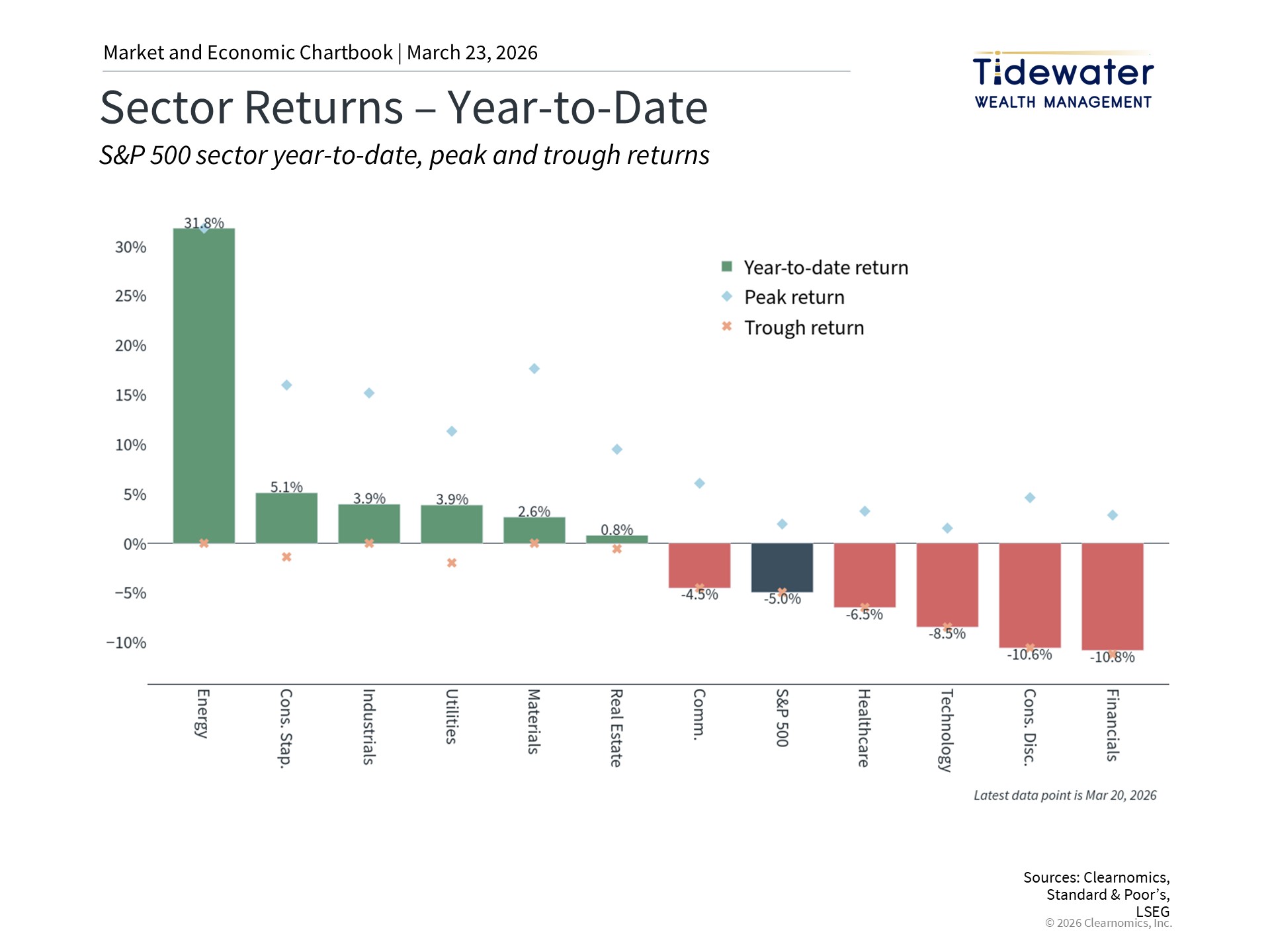
The energy sector — which includes companies that produce and supply oil, gas, and other fuels — has been one of the best performers in 2026, gaining around 30% year-to-date. This strong performance has been driven by a sharp rise in oil prices, with Brent crude (a global benchmark for oil pricing) hovering above $100 per barrel due to escalating tensions in the Middle East. The situation is still developing, which could continue to cause market swings. Historically, energy stocks have tended to rise during periods of global conflict.
For context, in 2022, when Russia invaded Ukraine, the energy sector gained 65.7% for the full year while the broader S&P 500 fell 18%. The year before that, energy returned 54.6% as the economy bounced back from the pandemic. While the overall market eventually recovered from those events, they show how energy stocks have often acted as a buffer during times of global uncertainty.
Oil prices first rose this year because of the blockage of the Strait of Hormuz — a critical waterway through which a large portion of the world’s oil travels — which forced many Middle Eastern countries to reduce oil and gas production. More recent attacks have also targeted energy production facilities directly. When oil prices rise, energy companies benefit because they earn more revenue and are motivated to invest more in finding and producing oil.
However, higher oil prices can also hurt the broader economy in the short term by raising costs for consumers, businesses, and many industries. This is why the same event that lifts energy stocks can put pressure on areas like transportation, consumer spending, and company profit margins in other sectors.
Over the longer term, there are reasons to remain cautiously optimistic about the impact of higher oil prices. Between 2011 and 2014, oil prices stayed near $100 per barrel and the economy still grew, with the stock market continuing to rise. Economists often describe these kinds of disruptions as "supply-side shocks," meaning they are typically temporary because production eventually resumes and other suppliers fill the gap.
In particular, the U.S. has been the world’s largest oil producer for six years in a row, with daily output now exceeding 13.7 million barrels. The U.S. is often called a "swing producer" because it has the capacity to increase production to help offset shortages from other parts of the world. This can help keep prices from rising too far and reduce the economy’s dependence on foreign oil supplies.
AI has raised new questions about technology companies
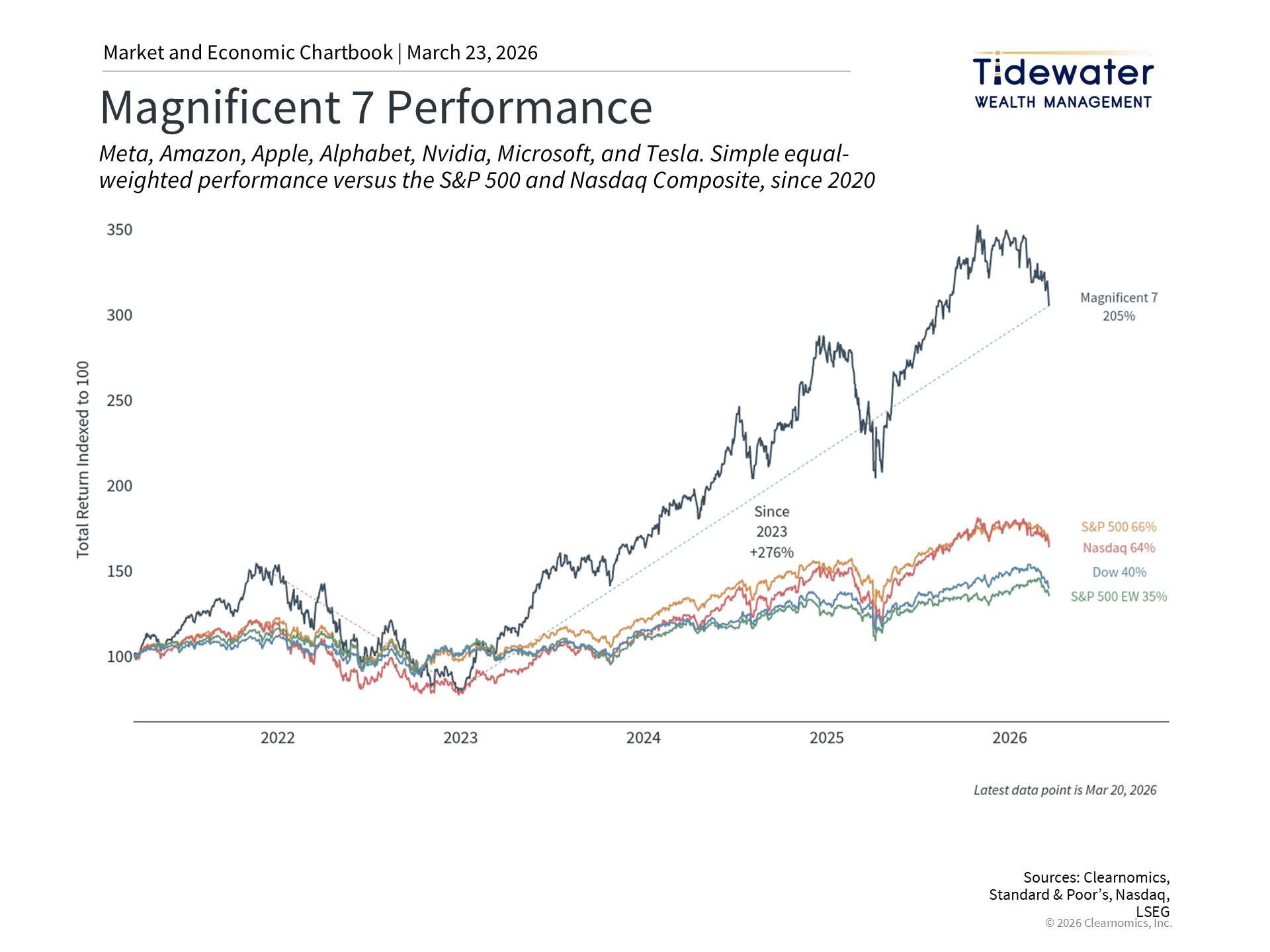
Over the past several years, AI-related stocks were among the top market performers, driving strong gains in sectors like Information Technology, Communication Services, and Consumer Discretionary. The success of these sectors — including the group of large technology companies known as the Magnificent 7 — led to a heavy concentration of the overall market in just a few companies.
More recently, however, the story has changed. While these companies are still reporting solid earnings, other sectors have performed well over the past year, including Energy, Industrials, Utilities, Materials, and Consumer Staples. Some of these groups are considered more "defensive" — meaning they tend to hold up better when the broader market is struggling — and they have benefited in this year’s market environment.
Part of the shift in sentiment around technology stocks comes from growing concern about how AI might affect existing software business models. Some have called this the "SaaS-pocalypse," referring to the idea that AI tools could disrupt traditional software-as-a-service (SaaS) companies — businesses that charge a recurring fee for software access. This debate is still ongoing, but the uncertainty alone has already contributed to a reassessment of how much these technology companies are worth.
This shift in market leadership does not mean technology stocks are no longer relevant. Rather, it shows how quickly the best-performing areas of the market can change. This is why investors should be careful not to put too much of their portfolio into any single sector, no matter how promising it seems. The goal of a portfolio is not to chase the highest-performing sector or stock, but to earn steady returns across different market conditions in a way that supports long-term financial goals.
Defensive sectors and broader diversification have supported portfolios
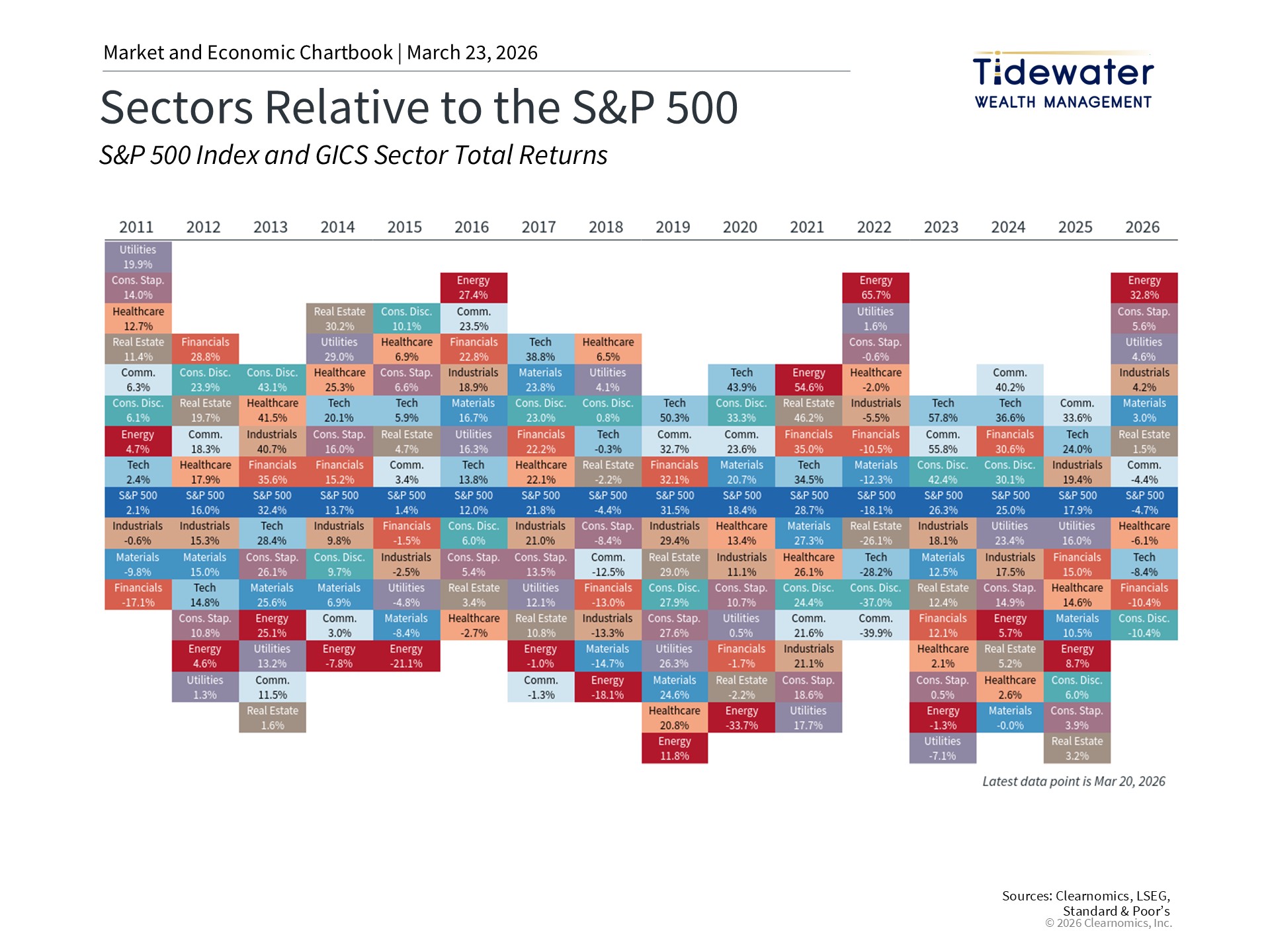
As uncertainty increased over recent months, investors moved toward traditionally defensive sectors such as Utilities, Consumer Staples, and, to a lesser extent, Health Care. Defensive sectors are those that tend to hold their value better during difficult times. This shift had already begun before the latest escalation in the Middle East, suggesting that investors were becoming more cautious even before the recent conflict, partly due to concerns about AI’s impact on technology companies.
Defensive sectors tend to do well when uncertainty and market volatility — or the degree of price swings in the market — increase. This is not because these companies are suddenly growing faster, but because their revenues tend to be more stable and less tied to the ups and downs of the broader economy. Utility companies still collect electricity bills, consumers still buy food, and people still need healthcare, regardless of what is happening in the world. These sectors also tend to pay higher dividend yields — meaning they return more income to shareholders on a regular basis. This combination of stability and income makes them more appealing when investors are worried about growth or inflation.
A related term that has emerged for stocks that are less vulnerable to AI disruption is "heavy assets, low obsolescence," or HALO. These are often defensive companies that make physical goods or rely on manufacturing processes that are not easily replaced by new technology.
Just as it is difficult to predict which type of investment will perform best in a given year, it is equally hard to predict which sector will lead or lag. The top-performing sector one year often falls near the bottom the next. Technology’s recent challenges, for instance, follow years of strong market leadership. This unpredictability is exactly why broad exposure across many sectors is so valuable.
A well-diversified portfolio — one that includes growth-oriented sectors like technology, economically sensitive sectors like energy, and defensive sectors like utilities and consumer staples — is better equipped to handle different market environments. Rather than trying to guess which sector will perform best next (which is just as difficult and counterproductive as trying to time the overall market), investors are better served by maintaining a balanced portfolio that can capture gains from multiple areas of the economy while managing overall risk.
The bottom line? This year’s S&P 500 performance serves as a reminder that spreading investments across sectors is a fundamental principle of long-term investing. Holding a broad mix of sectors is one of the best ways to keep a portfolio on track toward financial goals.