


Global events have been shaping financial markets, with high oil prices, geopolitical tensions, and new tariff rules drawing investor attention. One important factor behind many of these trends is the value of the U.S. dollar. Currency movements may not always make headlines, but they have a real impact on portfolios — affecting international investments, commodities like gold, and the overall economic environment.
A key development over the past several years has been the dollar’s decline from its 2022 high. More recently, the dollar has bounced back somewhat, as investors tend to seek out the safety of the dollar when global tensions rise. What does this mean for investors, and how does it connect to the performance of international stocks and precious metals like gold? Understanding these connections can help investors stay focused and keep their portfolios on track toward their long-term financial goals.
Three things investors should know about the dollar
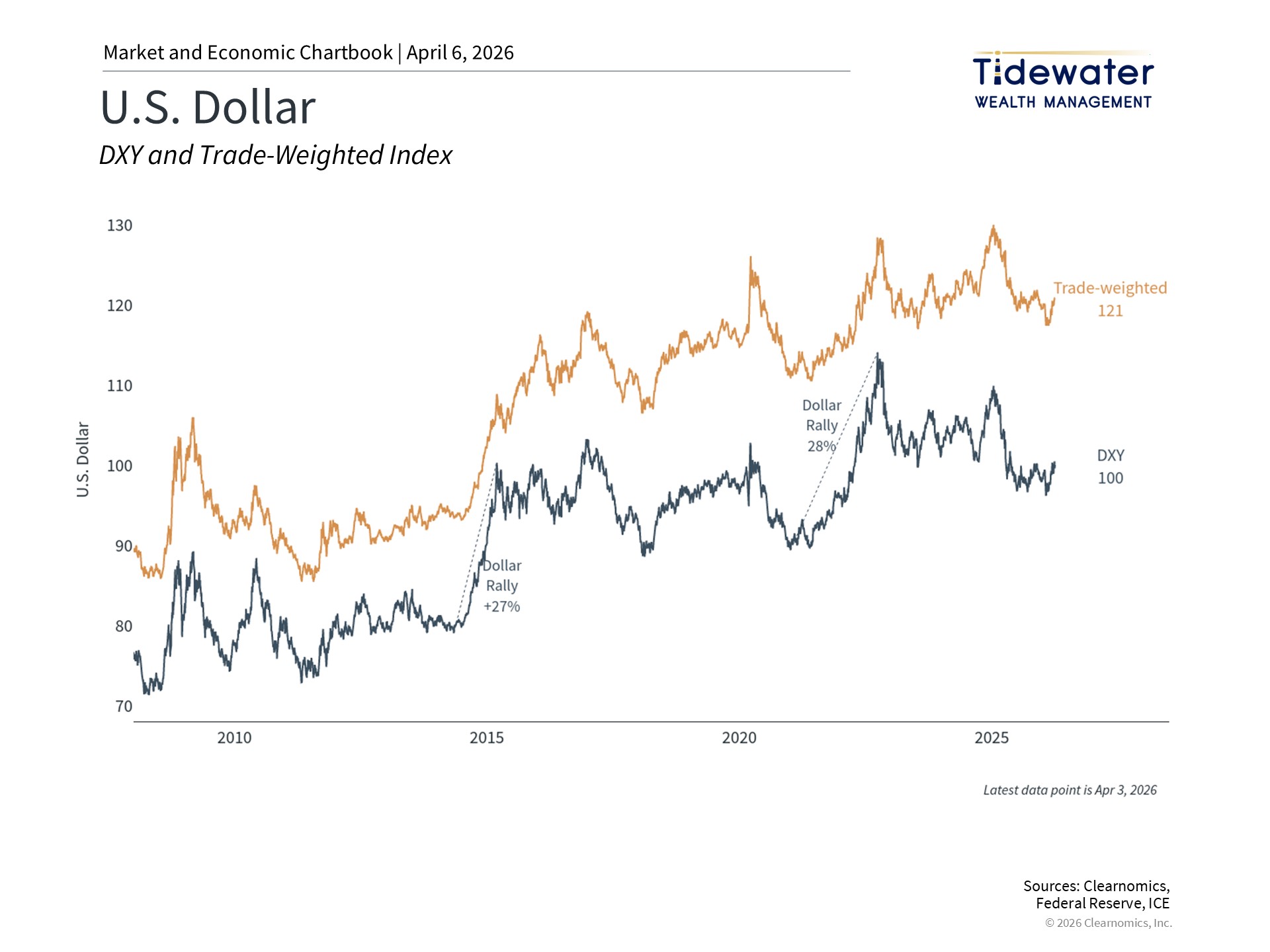
After peaking around 114 on the dollar index (DXY) in 2022, the dollar began to weaken as global growth steadied and investors started exploring opportunities outside the U.S. This trend picked up speed last year when tariffs pushed the dollar below 100 for the first time in three years. The dollar has since partially recovered in 2026, as geopolitical concerns have prompted investors to move toward safer assets. Looking at a longer time horizon, the dollar remains stronger than its historical average, even if it is below its all-time high.
There are three key things to understand about the dollar in today’s market. First, a stronger dollar is not always a good thing. For everyday consumers, a strong dollar is appealing because it makes imported goods and international travel cheaper. However, that is only part of the picture.
A strong dollar can create difficulties for businesses that sell products internationally, because those products become more expensive for buyers in other countries. This is one reason some countries have historically been accused of deliberately keeping their currencies weak — doing so gives their exports a price advantage. The ideal currency level is one that balances the needs of consumers, businesses, and the wider economy.
Second, from a big-picture economic standpoint, the dollar’s value is shaped by many global forces, including differences in interest rates between countries, trade flows, and government spending policies. These factors have shifted considerably in recent years as the Federal Reserve (the U.S. central bank) moved from raising interest rates aggressively to cutting them, and then pausing — all while new tariffs were being introduced.
Interestingly, last year’s tariffs did not strengthen the dollar as economic theory might suggest — they actually had the opposite effect. This is partly related to what is called the "debasement trade," which is the concern that government policies could gradually weaken the dollar’s economic standing over time. This includes large ongoing budget deficits, a topic that is expected to come back into the spotlight later this year due to budget discussions in Washington and the November midterm election.
Third, since late January, the dollar has risen from its recent lows as geopolitical tensions have led investors to seek safety in dollar-denominated assets — meaning assets priced in dollars. The dollar’s recent rebound is a reminder that during periods of global stress, both the dollar and U.S. Treasury bonds (government bonds) tend to attract investor capital. This reflects the dollar’s continued status as the world’s most important currency, especially during uncertain times.
The dollar still makes up the majority of global currency reserves and is used in a large share of international transactions. While concerns about the dollar losing its dominant status are not new — similar questions arose during Japan’s rise in the 1980s, after the euro was introduced in the early 2000s, amid China’s rapid economic growth, and more recently with the rise of digital currencies — investors still tend to return to the dollar during difficult periods.
A weaker dollar has helped boost international stock returns
One important effect of the dollar’s decline over the past year has been its positive impact on returns from international stock markets. In 2025, both developed markets (countries with well-established economies) and emerging markets (countries with faster-growing but less mature economies) delivered strong results. The MSCI EAFE index, which tracks developed market stocks, returned 31.9%, while the MSCI EM index, which tracks emerging market stocks, returned 34.4% — both measured in U.S. dollar terms. These returns were well ahead of the S&P 500, which tracks large U.S. companies, underscoring the value of investing globally.
To understand why currency movements matter, it helps to know how international investing works for a U.S.-based investor. When you invest in foreign stocks, those investments are priced in local currencies. This means you are effectively also holding those currencies. When the dollar weakens, converting those foreign currencies back into dollars results in more dollars — boosting your returns. So, currency movements play an important role in international investment performance, alongside the actual performance of the underlying stocks.
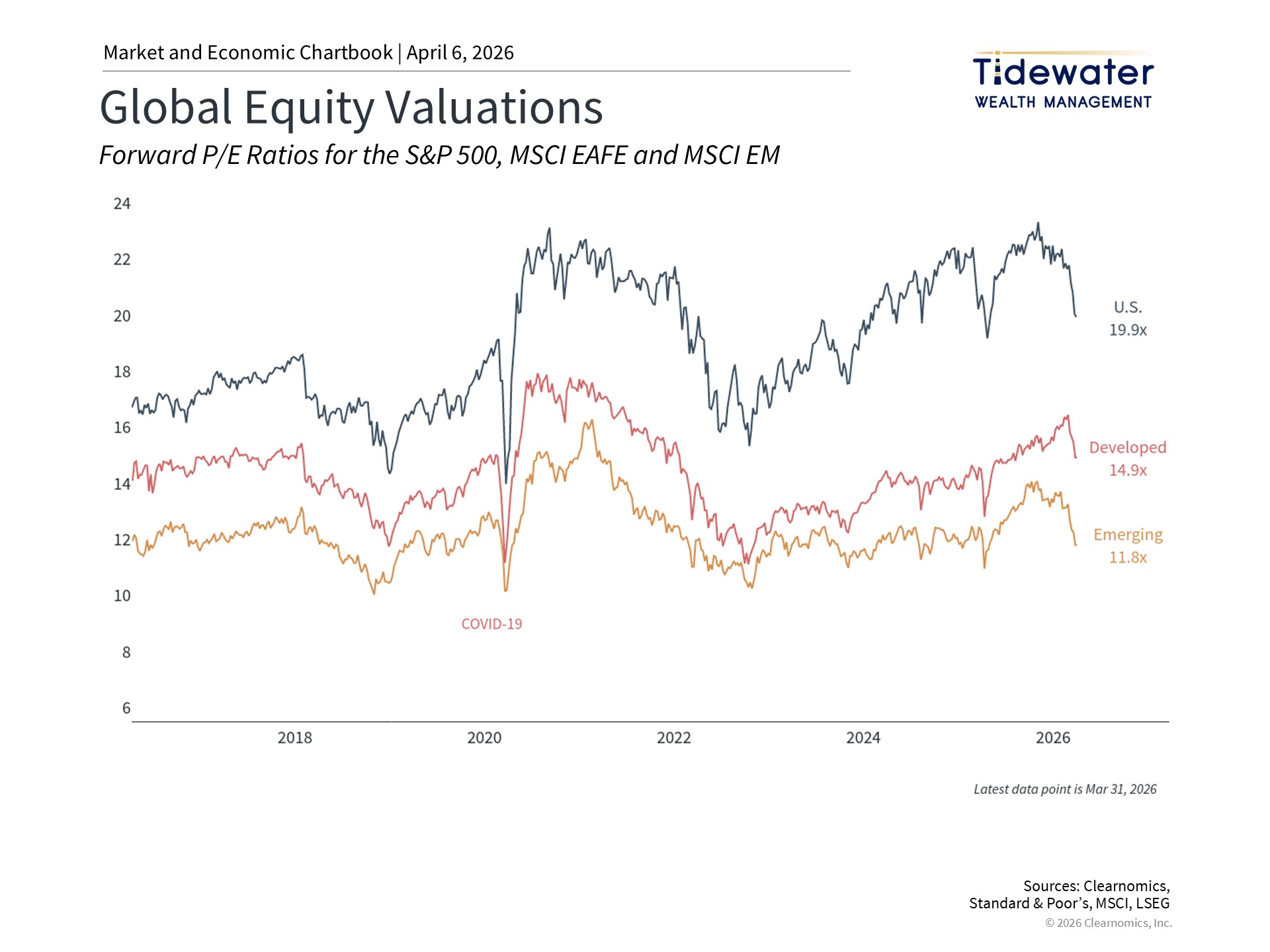
Valuations — a measure of how expensive or cheap stocks are relative to their earnings — also matter. International markets have been trading at a notable discount compared to U.S. stocks for some time. Developed market stocks have a price-to-earnings ratio (a common valuation measure) of 14.9x, and emerging market stocks are at 11.8x, compared to 19.9x for the S&P 500. This difference does not tell us exactly when to invest, but it is an important factor when building a balanced portfolio and deciding how much weight to give different assets.
So far in 2026, international markets have continued to slightly outperform the S&P 500, even as the dollar has partially recovered. Both developed and emerging markets are modestly positive on the year, while U.S. stock indices are slightly negative. Although the situation continues to evolve, this is a meaningful shift after years in which U.S. stocks consistently led global markets, causing some investors to question the usefulness of investing internationally. For long-term investors, this reinforces the idea that different types of assets take turns leading the market, and that maintaining exposure to global investments can help deliver more consistent portfolio results over time.
Gold has pulled back along with other assets
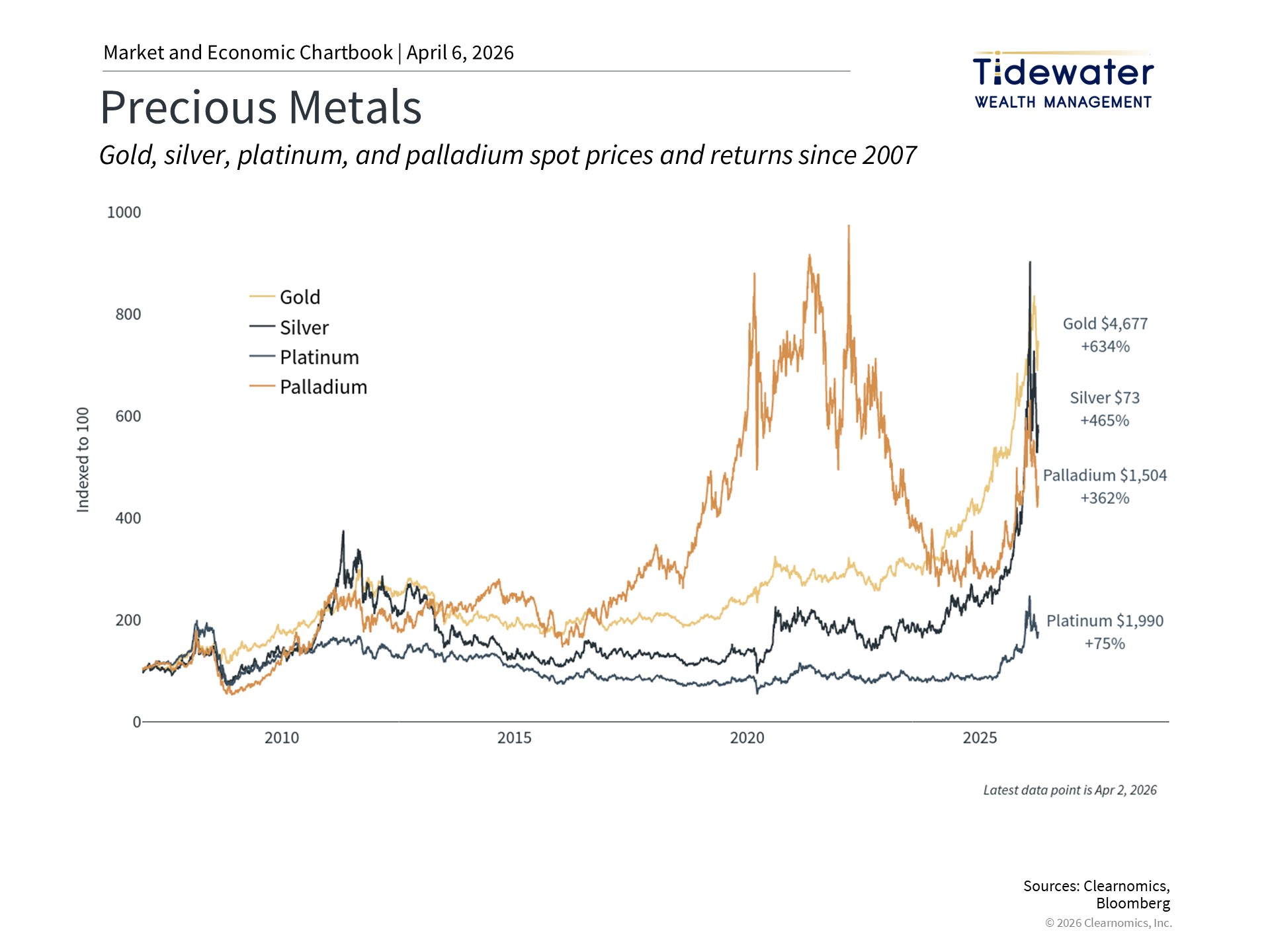
Gold has been one of the most talked-about assets in recent years, and its price is influenced by many of the same factors as the dollar. Rising government budget deficits, looser monetary policy (meaning lower interest rates), geopolitical tensions, and concerns about the dollar losing value over time all support the case for gold. These factors helped drive a strong multi-year rally, pushing gold prices to all-time highs as recently as late January, when gold reached $5,417 per ounce.
Since then, gold has fallen roughly 14% from that peak, even though geopolitical uncertainty has remained high and many of the supporting factors are still in place. This may seem confusing, especially for investors who hold gold specifically as a “safe haven” — meaning an asset that holds or gains value during turbulent times.
Part of the explanation is that gold had already attracted a lot of investor interest during its latest rally. When many investors buy gold in anticipation of further price gains, its price can start to move more in line with other assets rather than independently. For instance, during periods of market stress, gold may be sold alongside stocks, particularly as investors have shifted back toward the dollar. This is one reason gold’s recent decline has coincided with a strengthening dollar.
This is not the first time gold has behaved this way. Between 2011 and 2020, gold was essentially flat in price, even as the Federal Reserve kept interest rates very low for much of that period and financial markets went through several major bouts of uncertainty. Gold was also relatively flat during the high-inflation period from 2022 to early 2024, which would typically have been considered favorable for gold. However, the Fed raised interest rates rapidly during that time, making cash and short-term investments more attractive by comparison.
As always, the most useful way to think about the dollar, international investments, and gold is as components of a broader portfolio rather than as standalone bets. The value of these assets lies in the fact that they tend to behave differently from stocks and bonds, and therefore help to smooth out portfolio performance over time.
The bottom line? The dollar, international stocks, and assets such as gold can all serve different roles in balanced portfolios. During periods of uncertainty, it’s important to maintain a broader perspective on the driving factors behind these assets. Ultimately, a well-constructed portfolio remains the most reliable way to achieve long-term financial goals.