

The U.S. dollar plays a central role in financial markets, the broader economy, and daily life. It is not just a currency used to buy goods and services. Its value is shaped by expectations around interest rates, inflation, and trade, among other factors.
Many Americans tend to prefer a stronger dollar because it makes imports and international travel cheaper. However, a weaker dollar can actually help businesses that sell goods abroad, since their products become more competitive in other countries. For investors, currency movements can have a meaningful impact on portfolio returns, so it is worth understanding what drives them.
After falling when new tariffs were introduced last year, the dollar has since steadied and has even gained some ground in recent weeks. Concerns about the national debt and central bank policy can create uncertainty around the dollar, and can push investors toward other assets like gold and Bitcoin, which some view as alternatives to the dollar.
These trends are tied together by what is sometimes called the "debasement trade." This is the idea that government policies will steadily erode the dollar's value over time. While this concept has attracted a lot of investor attention in recent years, recent developments suggest the picture is more complicated. A closer look at the factors driving the dollar, gold, and Bitcoin can help explain what has been happening, and how each fits into a well-rounded investment portfolio.
The dollar has found its footing over the past year1
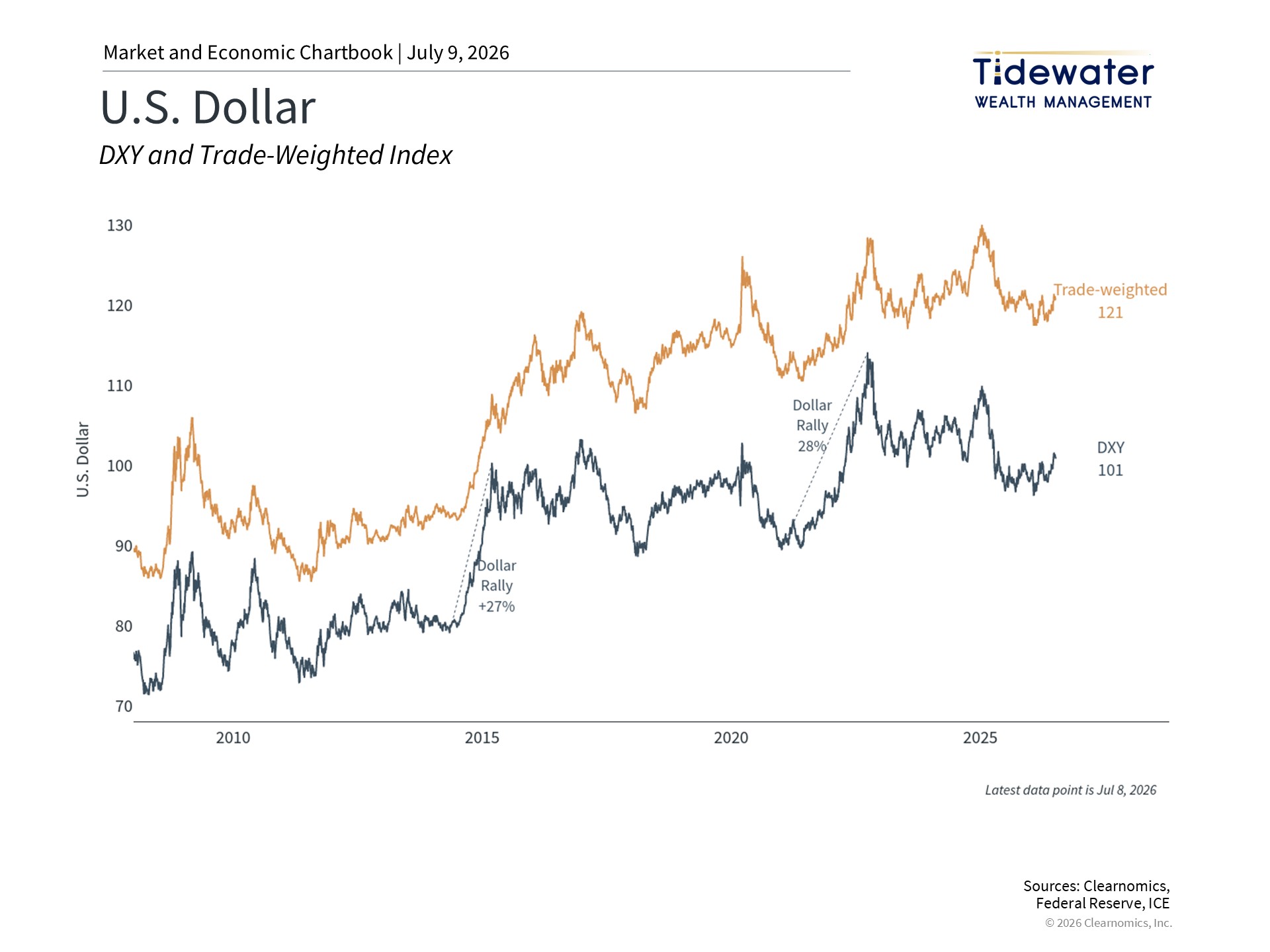
The dollar's drop in 2025 was caused by a mix of factors: new tariffs, worries about government budget deficits, and shifting expectations for Federal Reserve (the U.S. central bank) policy. The response to tariffs was somewhat surprising. In theory, higher tariffs reduce imports, which means less need to exchange dollars for foreign currencies, and that should make the dollar stronger. Instead, the opposite happened. Businesses, governments, and central banks around the world moved away from the dollar because the new trade policies created so much uncertainty.
At its weakest point, the dollar index fell well below 100 for the first time in several years. Since then, it has steadied and recovered somewhat, and it still remains much stronger than its long-term historical average. A few things have helped support the dollar's recovery. First, the Federal Reserve did not rush to cut interest rates, even as concerns about the job market grew. In fact, there was even some discussion about the possibility of rate increases. Higher interest rates in the U.S. compared to other countries tend to attract foreign investors seeking better returns, which brings money into dollar-denominated assets and supports the currency.
Second, the Japanese yen has weakened significantly, recently falling to near 163 yen per dollar, a 40-year low.2 This reflects a large gap between interest rates in the U.S. and Japan, where Japan's central bank has only been raising rates very gradually. A weaker yen makes the dollar look stronger by comparison, even if the dollar is losing ground against other currencies. Japanese officials may step in to support the yen, but historically such efforts have only provided short-term relief, since Japan's lower interest rates reflect deeper structural challenges like an aging population and slower economic growth.
Third, geopolitical tensions, including conflict with Iran, have at times pushed investors toward the dollar as a "safe haven," meaning a place to park money during uncertain times. The recent agreement between the U.S. and Iran has reduced some of that demand, reminding us that currency values can shift quickly when the geopolitical situation changes.
It is worth noting that the dollar remains the world's leading reserve currency, meaning it is the currency most widely held by central banks and used in global trade. This role is deeply established in the global financial system. Similar concerns about the dollar's future came up during Japan's economic rise in the 1980s, after Europe introduced the euro, and during China's rapid growth. In each case, the dollar held its central position. While other currencies and cryptocurrencies may gradually gain ground, that kind of shift would likely take decades, not years.
Gold has dropped sharply after reaching record highs
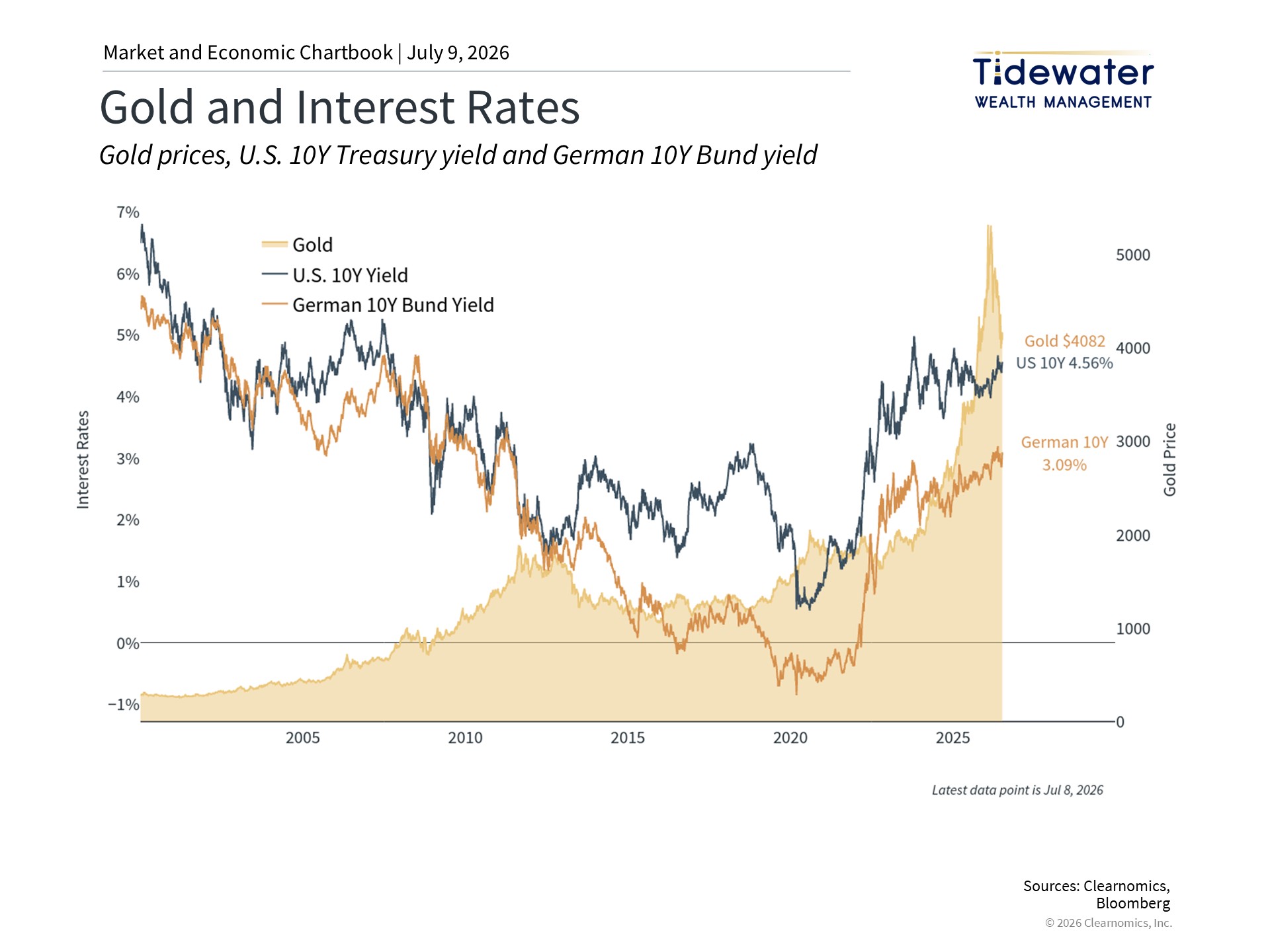
Many of the same forces have contributed to gold's steep decline from $5,400 to around $4,100, a sharp reversal for an asset that many investors had turned to as protection against government spending concerns, a weaker dollar, and global instability.3 Over the past two years, gold had benefited from a number of tailwinds, including a declining dollar, rising purchases by central banks looking to reduce their dependence on dollar assets, ongoing geopolitical tensions, and growing interest from investors seeking assets that hold their value. All of these factors pushed gold prices to levels that already reflected high expectations for continued gains.
As the dollar has stabilized and partially bounced back, gold has reversed course. The easing of some geopolitical tensions following the U.S.-Iran agreement has also reduced the demand for gold as a safe haven. In addition, with the Federal Reserve keeping interest rates steady rather than cutting them, the cost of holding gold has effectively increased. Gold pays no interest or dividends, so when interest rates are higher, investors give up more potential income by holding it.
Gold, like many commodities, tends to go through cycles of strong gains followed by sharp declines. After surging during the high inflation period of the late 1970s, gold peaked above $800 per ounce in 1980 and did not return to that level until 2007. After the 2008 financial crisis, it roughly doubled to nearly $1,900 per ounce by 2011, then fell back toward $1,000 over the following years, even as the Federal Reserve kept interest rates very low.
Bitcoin has struggled even while the stock market has climbed
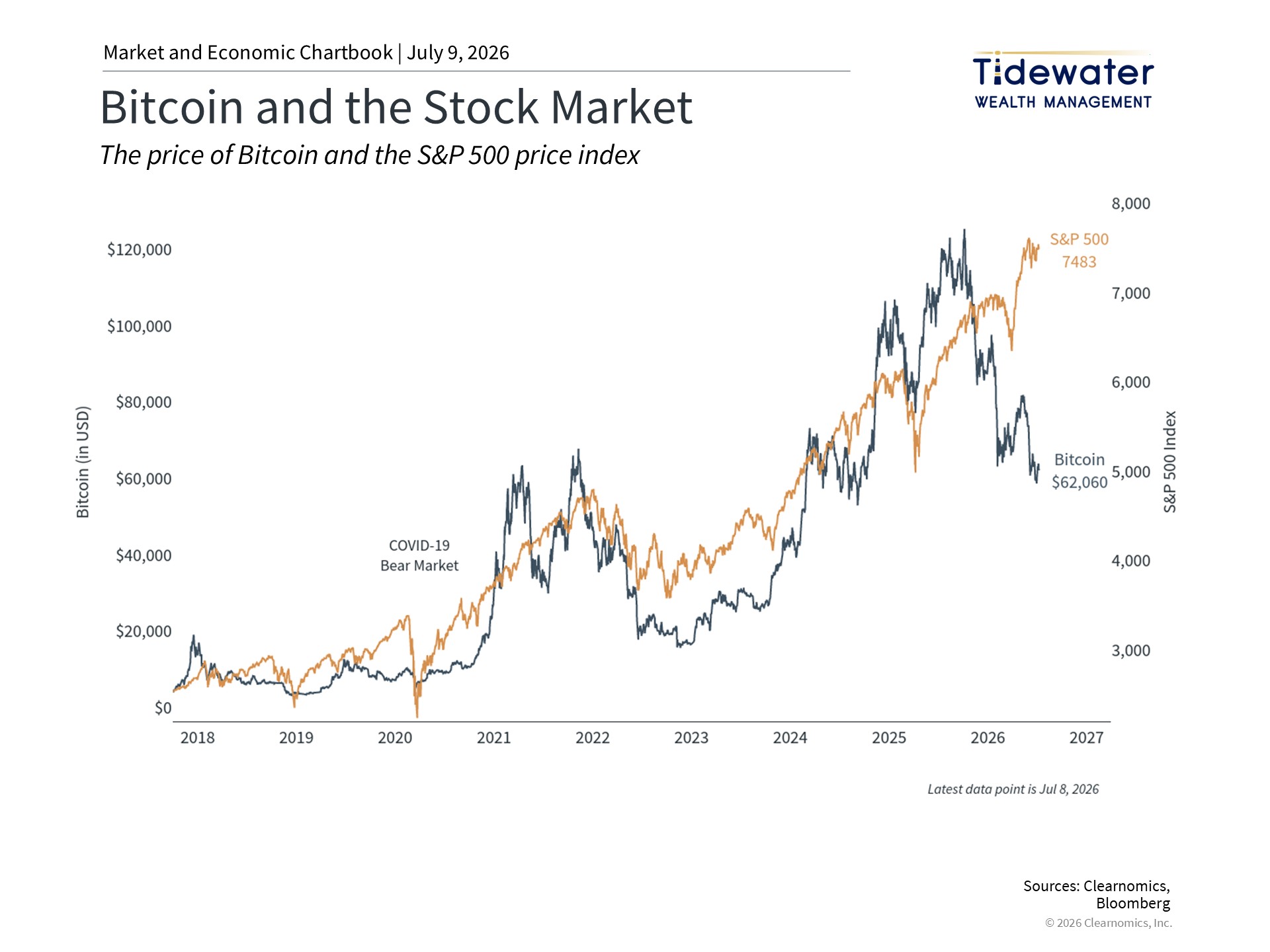
Some investors hold Bitcoin as an alternative to the dollar or other traditional investments. However, Bitcoin has not behaved like a safe haven asset. In practice, it is very hard to predict how Bitcoin will perform in any given environment, other than the fact that it tends to move in line with the broader market. Bitcoin and other cryptocurrencies are typically very volatile, meaning their prices can swing dramatically. They tend to rise when investors are feeling confident and willing to take on risk, and fall when uncertainty increases.
Bitcoin's recent behavior may surprise investors who expected it to benefit from the same concerns that temporarily lifted gold. While Bitcoin did reach a new all-time high of around $125,000 last October, it has since fallen to around $60,000. This has happened even as the broader stock market has rallied, driven largely by companies involved in artificial intelligence.
This kind of volatility and unpredictability is why it is important to think of Bitcoin and similar assets as just one part of a broader, balanced portfolio. Like gold, Bitcoin generates no income, so its value depends entirely on price appreciation. Unlike gold, Bitcoin has a much shorter history and still faces considerable uncertainty. Price swings of 50% or more in a single year are not unusual for Bitcoin, as recent experience and the events of 2022 both illustrate.
The broader takeaway for long-term investors is that the value of any single asset, whether it is the dollar, stocks, bonds, gold, or Bitcoin, should be considered in the context of an overall portfolio. Each of these assets has different characteristics that can contribute to investment outcomes under different conditions. Choosing the right mix of asset types that aligns with your long-term financial goals is the most effective way to pursue growth while managing risk.
The bottom line? The dollar, gold, and Bitcoin have all experienced notable swings over the past year, reflecting changing views on economic growth, geopolitics, and central bank policy. Investors should keep a portfolio-wide perspective and remain focused on their long-term goals.
References
1. Based on the DXY index as of July 3, 2026
2. https://www.cnbc.com/2026/06/30/japan-yen-falls-lowest-level-since-1986-dollar-intervention-risk.html
3. From January 28, 2026 to July 3, 2026
Index Descriptions
DXY
The DXY is a U.S. dollar index based on a basket of currencies, including the Euro, Yen, Pound, Canadian Dollar, Swedish Krona and Swiss Franc.